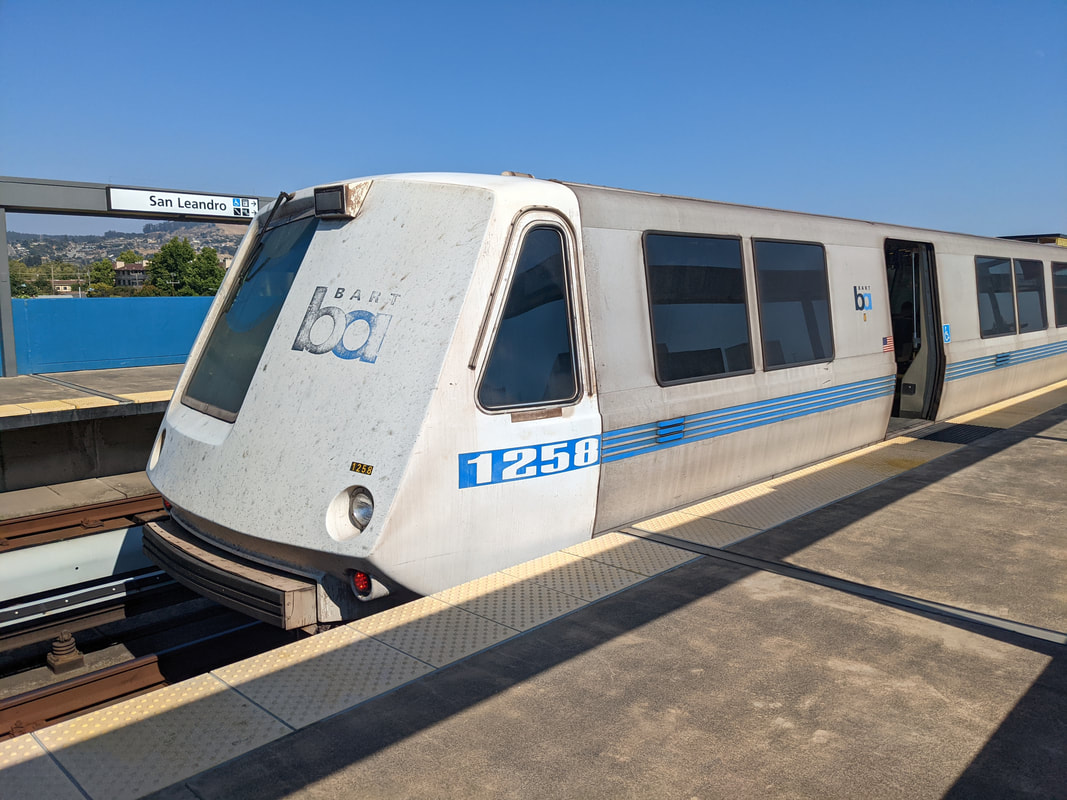
 Let's take a look at another random A2 car - this time, the old 1258. Originally built as A car 258 in 1975, by Rohr, and delivered to BART on June 18, 1975. Things were so bad back then that the final A cars, including 258, were delivered without carborne ATC equipment - they were essentially mothballed right out of the factory. Like many other late A cars, the 258 lost her motors and didn't enter service till the late 1970s. She was rebuily into A2 car 1258 in 2002 by Bombardier, and 21 years later is still rolling around the system on Orange and Red line trains. She has a little patch below the left cab window. 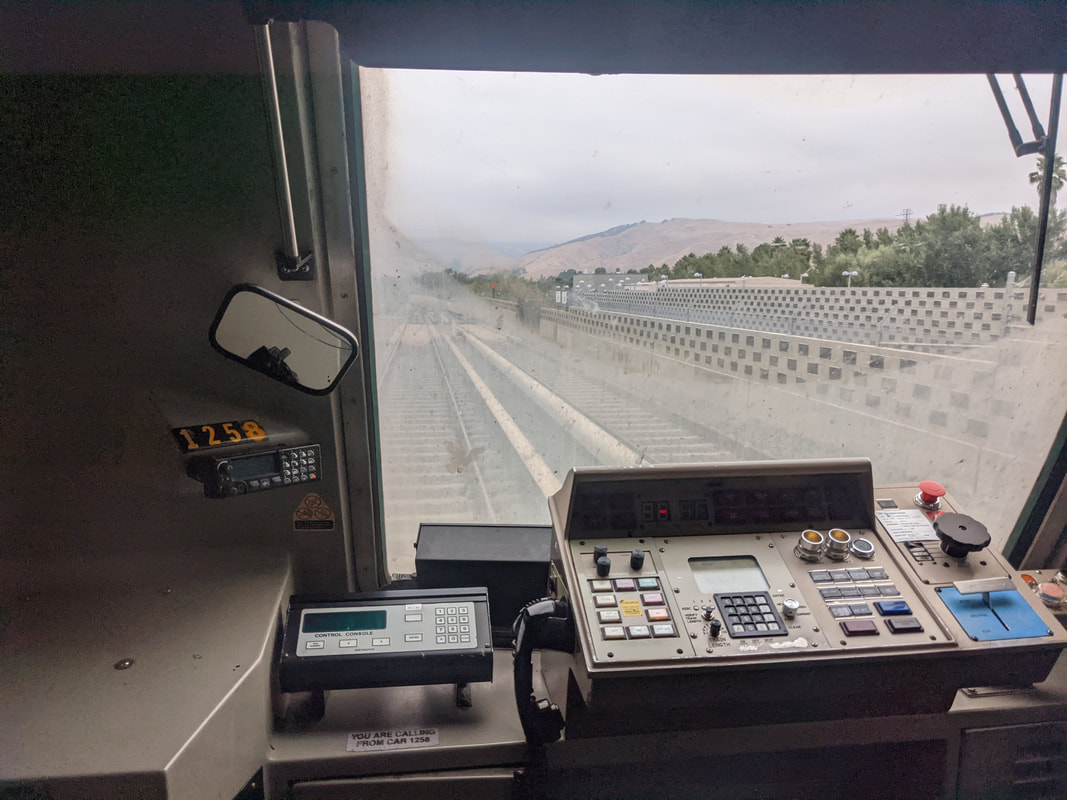 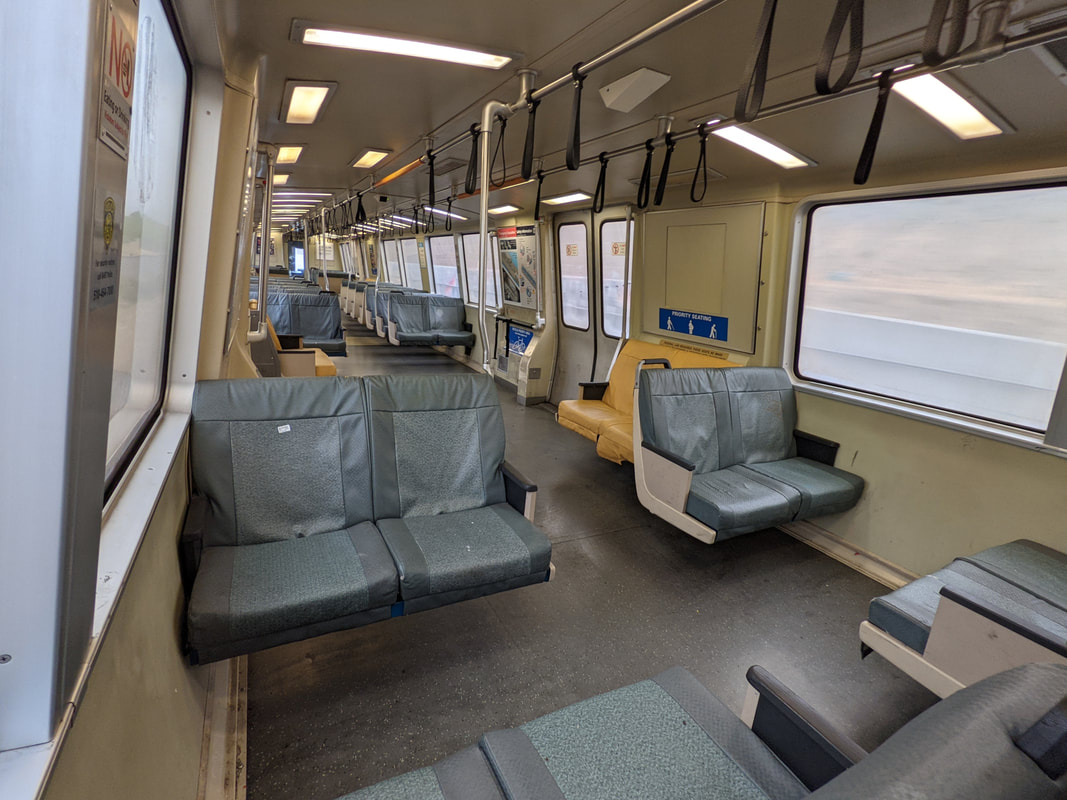 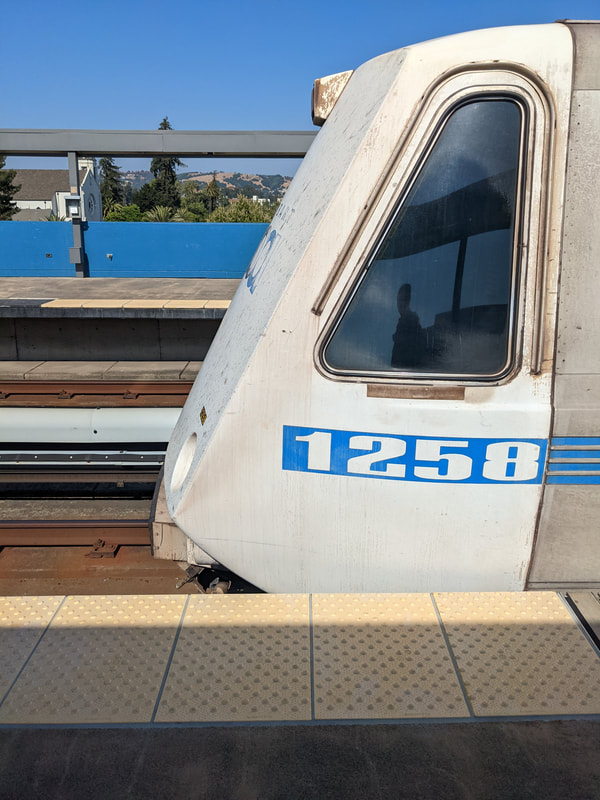
1 Comment
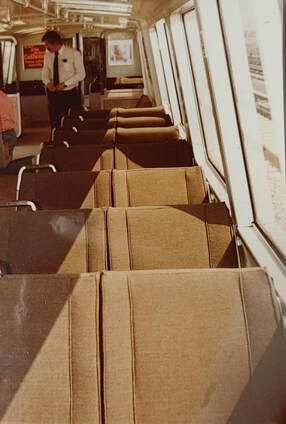
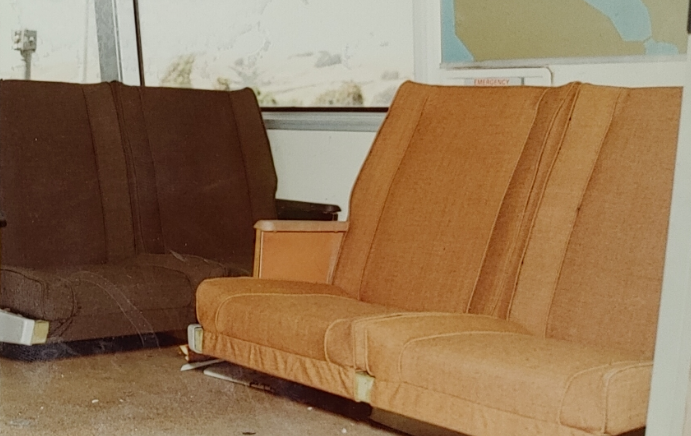
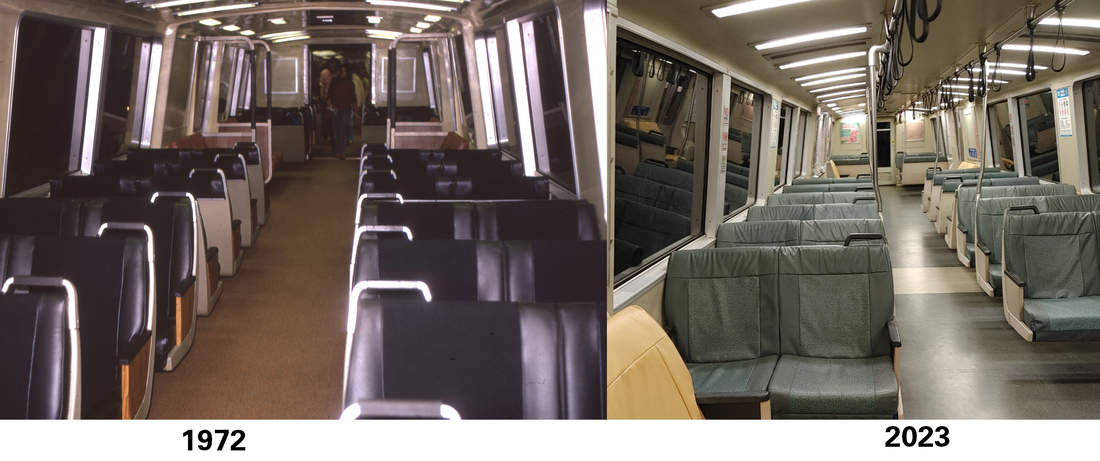 BART was designed to compete with the automobile commute in both speed and comfort. Paramount to the success of the system, its designers thought, were considerations for plenty of comfortable seats – allowing for virtually every passenger to sit during their commute. Seventy two wide, upholstered cantilevered seats (22 inch width, 34 inch pitch) would equal the comfort of automobile, allowing passengers to read, write, sleep, or simply enjoy the view at 80 miles per hour. This is a brief article on the different types of seats on the BART legacy cars throughout the past 50 years. (To note, this article does not discuss the changing seat layouts, which will appear in a separate article) 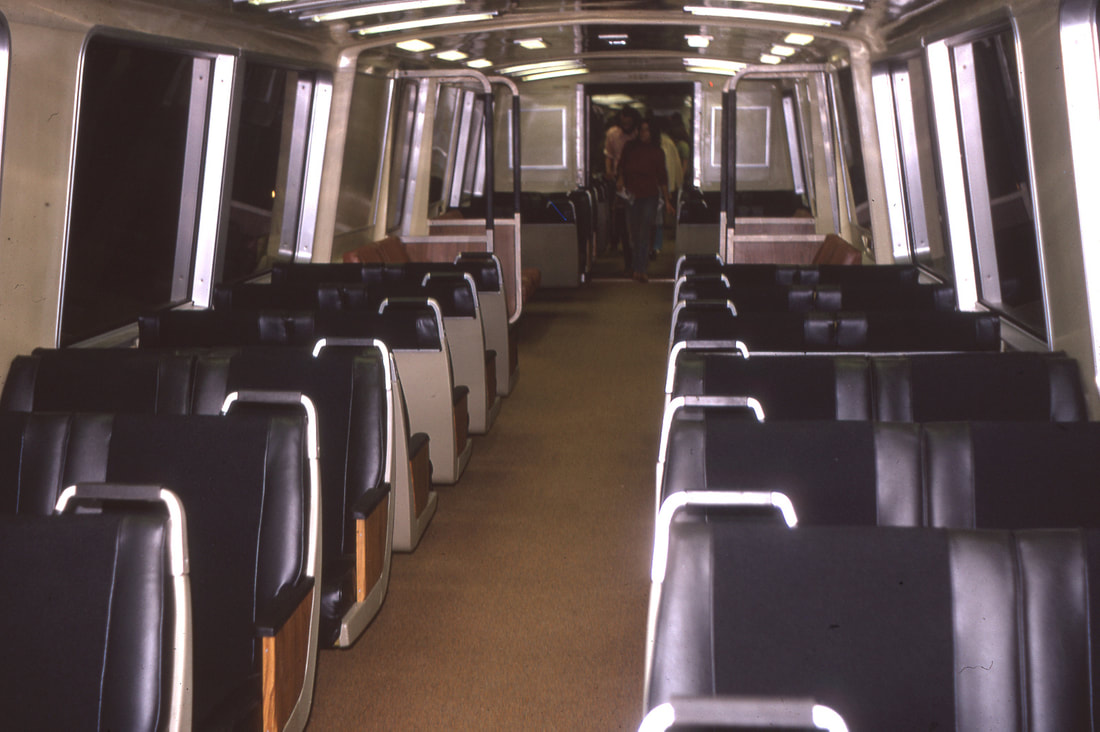 WRM Archives The original seats from BART’s opening day (September 11, 1972) were black and copper colored vinyl and plastic-coated fabric seats, with polyurethane cushions, made by American Seating Company.
The 1979 fire in the Transbay Tube resulted in a fire hardening program to prevent and mitigate the effects of any future occurrence. During this incident, a line switch box cover off of car 537 fell onto the trackway. Several trains later, incident train 117 hit the line switch box cover and/or the damaged third rail, resulting in short circuits and a fire. The fire, including burning polyurethane seats, immediately led to heavy smoke containing hydrocyanide - of which later killed a firefighter. The replacement seats under the fire hardening program were made with a 90% wool, 10% nylon material with neoprene cushions. 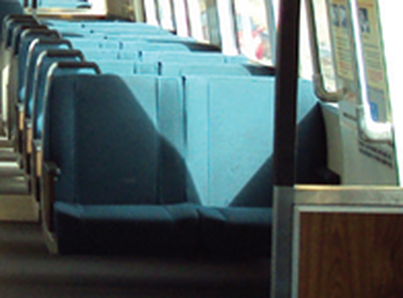 BART Picture The brown wool seats were replaced in the 1990s and 2000s with blue wool seats. In 2011, the Bay Citizen commissioned a supervisor at the biology lab at San Francisco State University to analyze the bacterial content of a BART seat in a revenue train. They found high concentrations of nine bacteria strains and several types of mold on the seat. The tests produced mixed results for Methicillin-resistant Staphylococcus aureus (MRSA), sometimes known as a “superbug” bacteria due to its resistance to common antibiotics. Additionally, the test found two other bacteria strains traced back to fecal contamination of the seats. One of the strains was noted as resistant to antibiotics while the other was noted as non-harmful and commonly found in the environment. 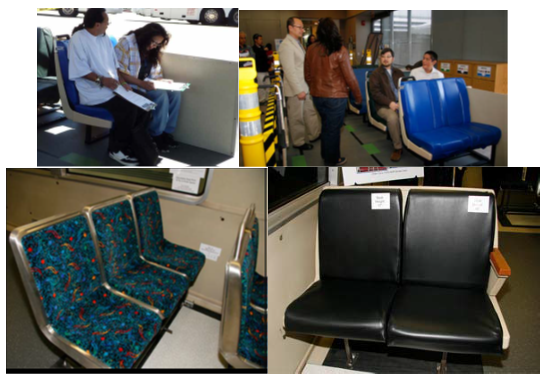 BART pics Following this news, there was increased pressure for BART to replace these wool seats with a safer alternative. BART launched a series of seat laboratories to solicit rider opinions on alternative seating materials. The alternatives included synthetic fabric, wool-based fabric, hard plastic, and vinyl upholstery. Sixty two percent of riders selected vinyl above the other materials, and vinyl also carried significant cost savings. New wool seats costed $15,000 per car, had a lifespan of 3 years and $600,000 annual fleetwide cleaning costs. Vinyl seats costed $10,000 per car, had a lifespan of 10 years, and $100,000 annual fleetwide cleaning costs.
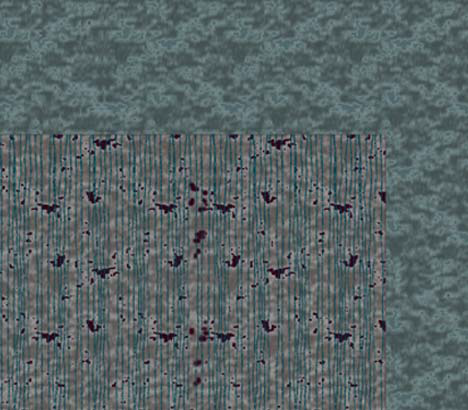
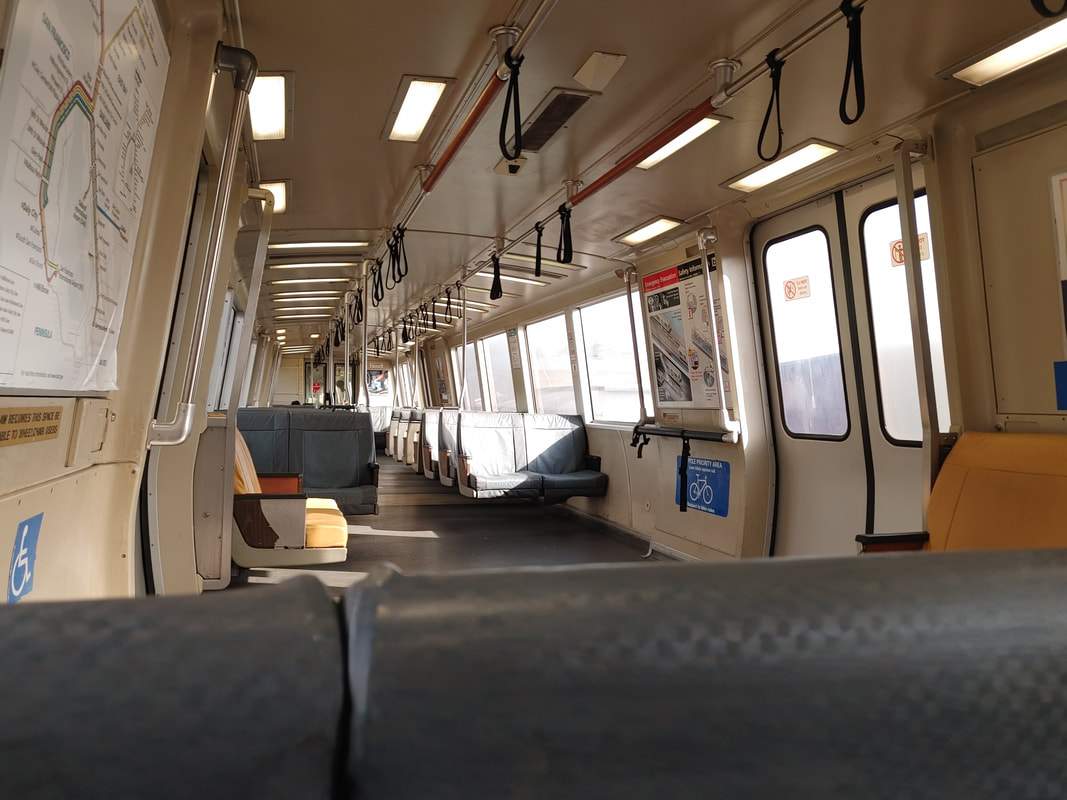
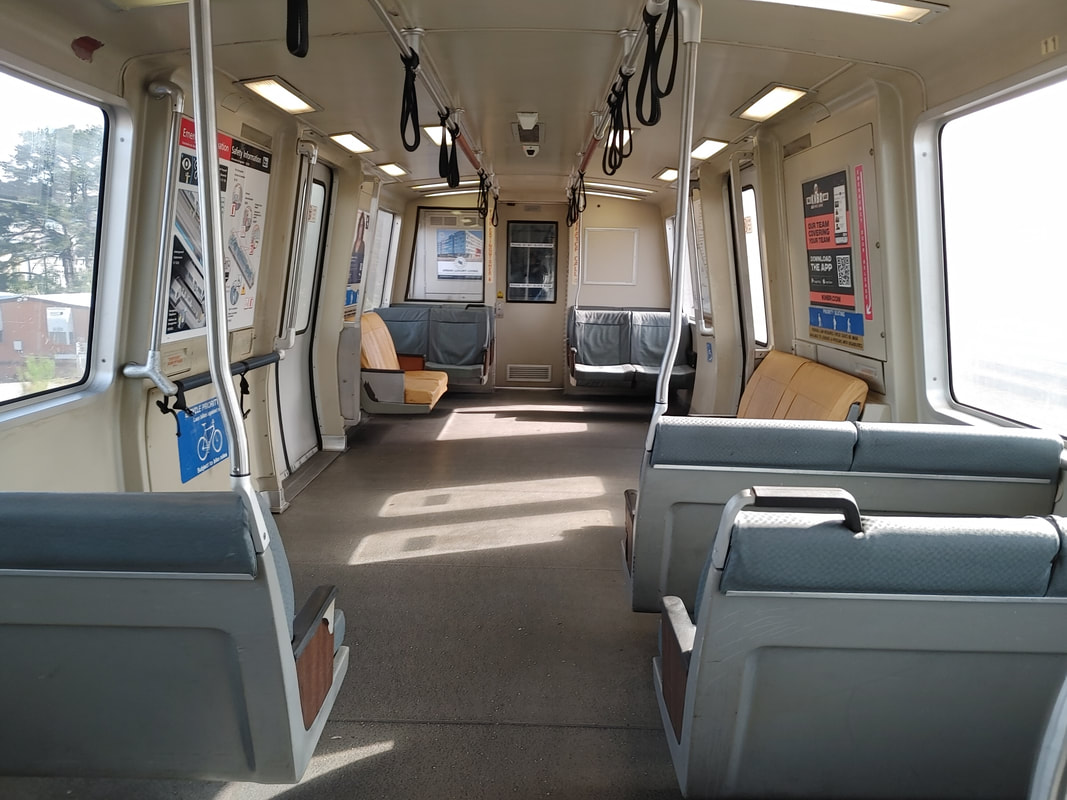
BART selected the OMNOVA Solutions PreVail Transit upholstery with PreFixx Extreme top coating as the replacement for the old wool seats. OMNOVA collaborated with a BART-hired independent colorist to produce the seat pattern, titled “Water, Wine, and Waves,” a design reflecting the San Francisco Bay, Pinot Noire wine, and lines of activity. 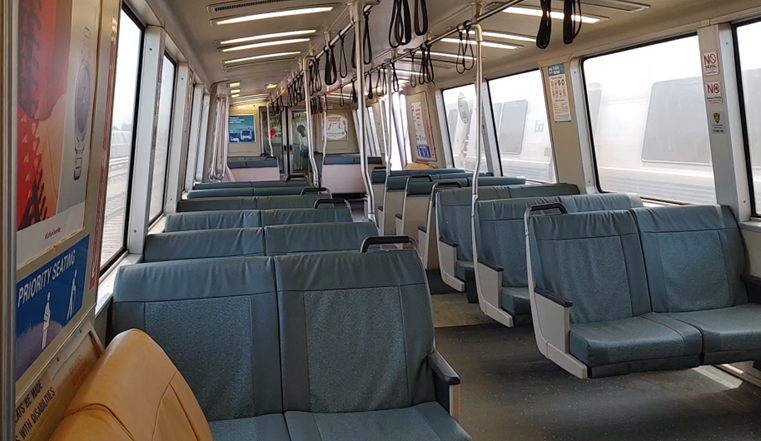 The installation of the seats started in April 2012 on a trial basis of 100 cars, including 20 with new flooring, 20 with new carpets, and 60 with old carpets. Cars with the new seats received a special decal. By September 2014, 439 of the 669 cars had the new seats, and the final car with wool seats, C1 car 335, received new vinyl seats on December 30, 2014. To note, many cars retained wool operator seats through their final years. 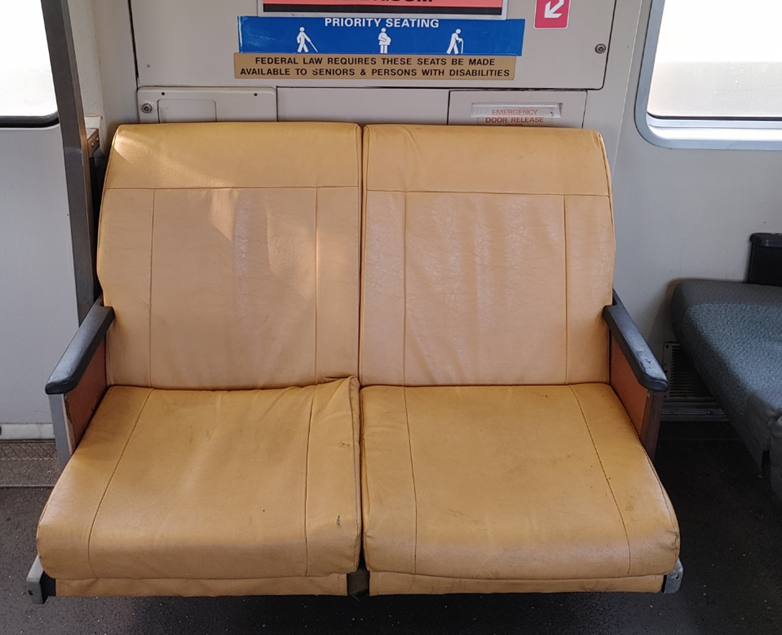 In 2018, BART [re]introduced a mustard-yellow fabric for priority seats, designated for priority use by seniors, persons with disabilities, and pregnant women. To note, there were mustard-yellow seats back in the early days. OMNOVA also provided a “Take Back Vinyl Reclamation Program” for the seats, but it appears this benefit was not fully taken up. By 2023, dozens are cars were scrapped with most to all seat cushions still in place. Sources:
"BART Railcar Fleet: Cushion and Cover Assemblies. Board Briefing November 17, 2011. "BART Seats: Where Bacteria Blossom" https://web.archive.org/web/20110308013857/http://www.baycitizen.org/transportation/story/bart-seats-bacteria-blossom/ "Final Report on 1/17/1979 Transbay Tube Fire", Board of Inquiry, March 5, 1979 "New seats now in all trains" https://www.bart.gov/news/articles/2015/news20150102 "PreVail Transit™ Vinyl Upholstery Leaves Lasting Impression with BART." OMNOVA Solutions, June 2012 "Two Years Into BART Vinyl Seating Retrofit: Costs Down, Satisfaction Up." Omnova Solutions, September 2014 Originally built as A car 272 by Rohr, and among the last A/B cars to be delivered (July 1975). It was rebuilt in 2002 by Bombardier as A2 car 1272. It's looked a bit rough since 2017, with the "a" in "ba" faded alongside the Y end (cab) side numbers. Here it is, one sunny afternoon approaching Union City platform 2 on a Richmond train. Mission Peak, Mount Allison, and Monument Peak loom in the background. 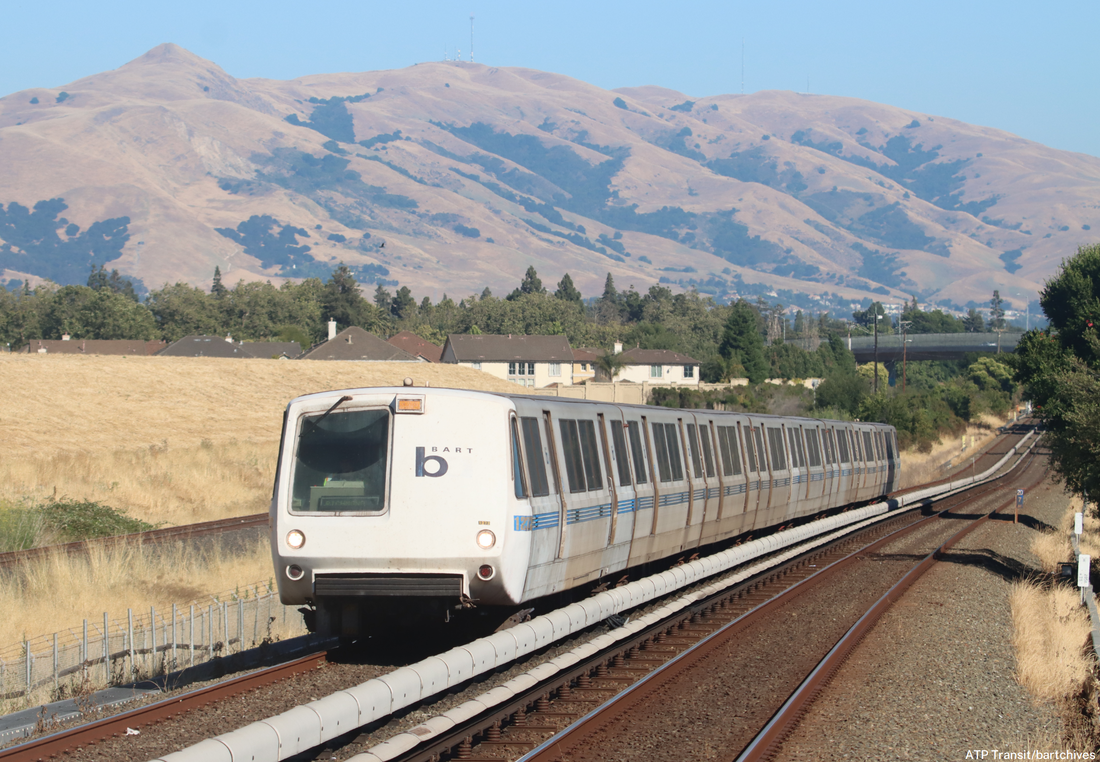 WRM recently received a truck from BART. The truck was sourced from a recently retired and scrapped B2 car. The truck itself is an original Rockwell model HPD-3 inboard bearing, cast steel truck, designed and used by BART’s A and B cars, and later refurbished and used on the A2 and B2 cars. The image below shows various components of the truck as originally built. 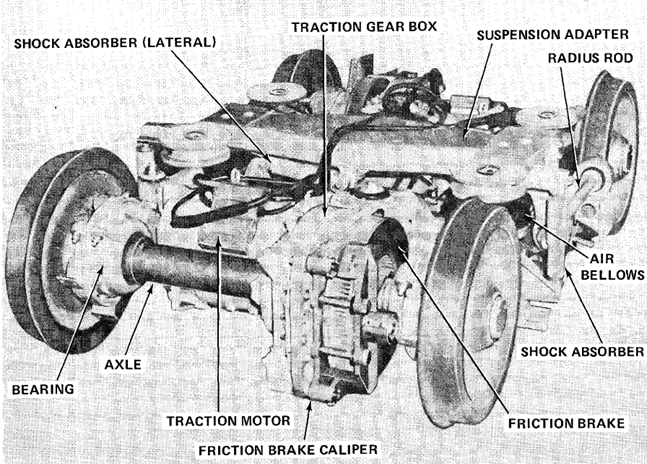 Compare to below 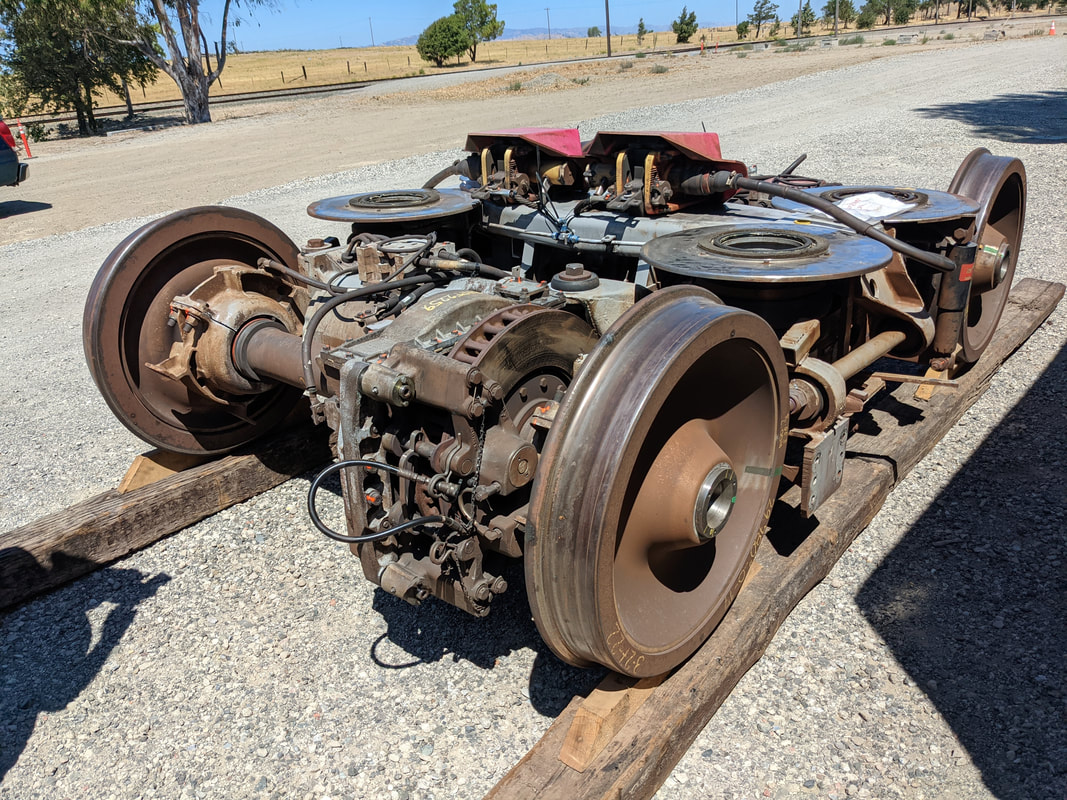 This particular truck, serial #2368 has a build date of 1970 as seen by the builder’s plate. 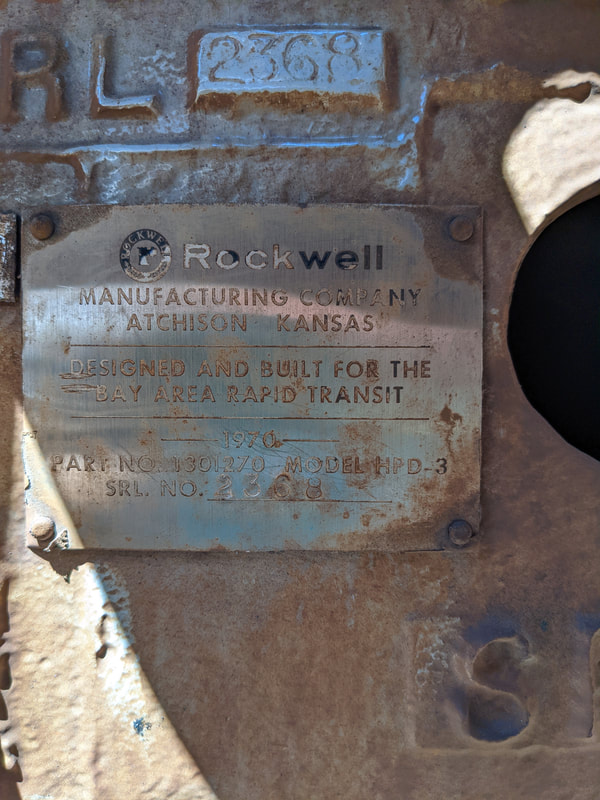 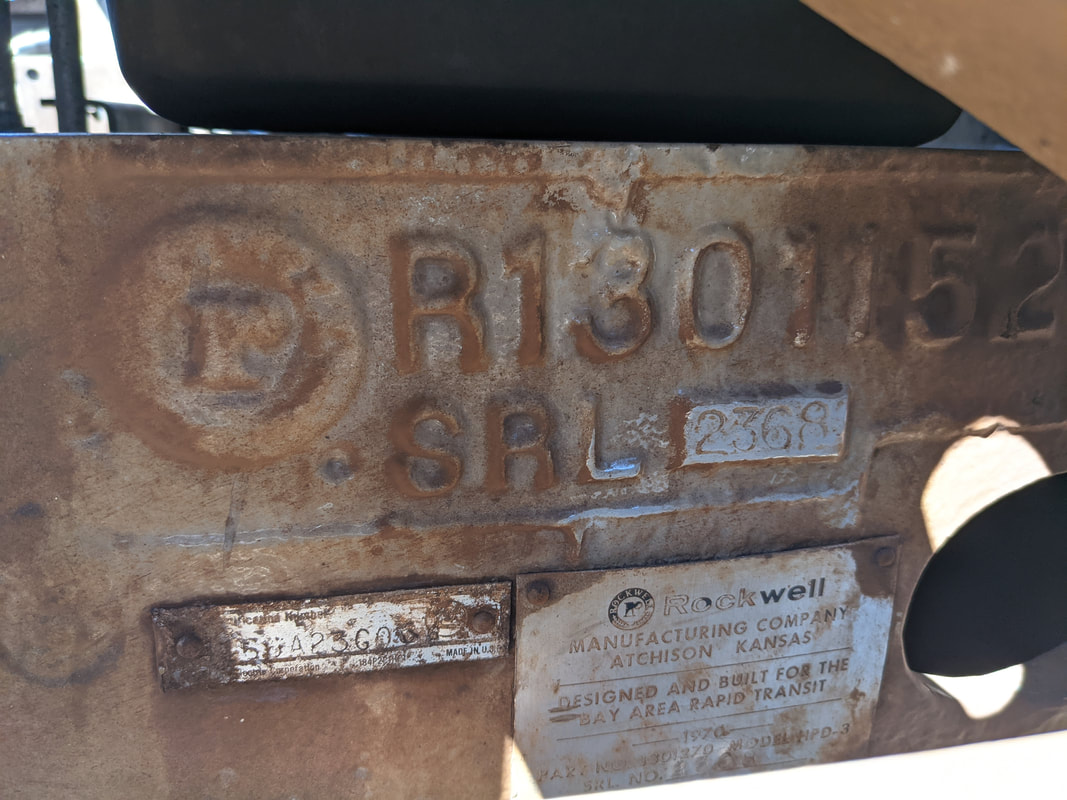 During the midlife refurbishment of the A and B cars into the A2 and B2 cars in the late 1990s and 2000s, these Rockwell trucks were refurbished and replaced their Westinghouse 1463 DC motors with Adtranz 1507C AC motors. 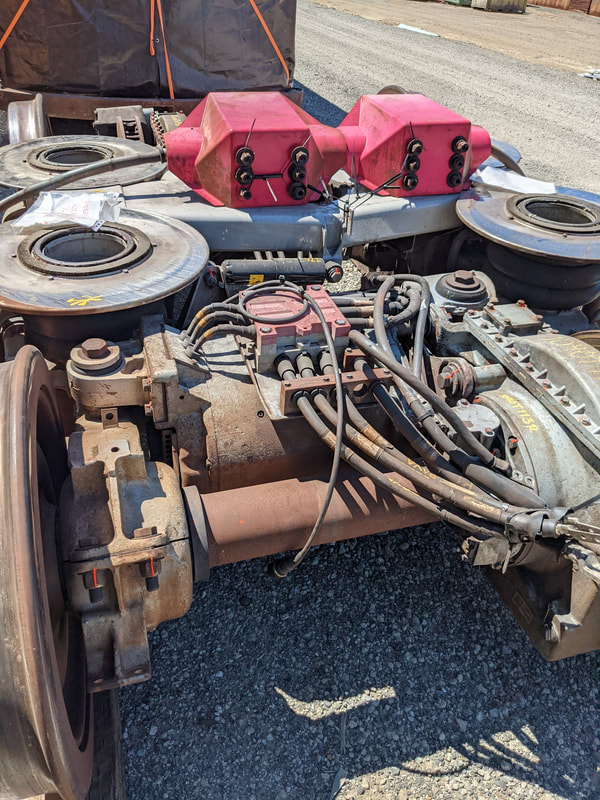 The third rail shoe and related assembly (in red, stored on top at the moment) picks up 1000 volt DC third rail and feeds it to the propulsion system (inverter) located underneath the carbody. Then, AC power and commands from the car powers the two motors, moving the truck (and the car mounted on the truck). 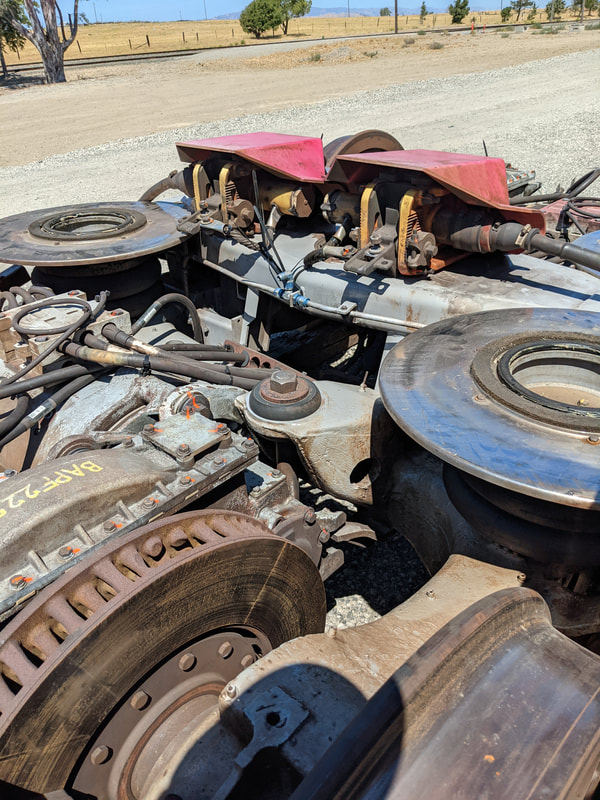 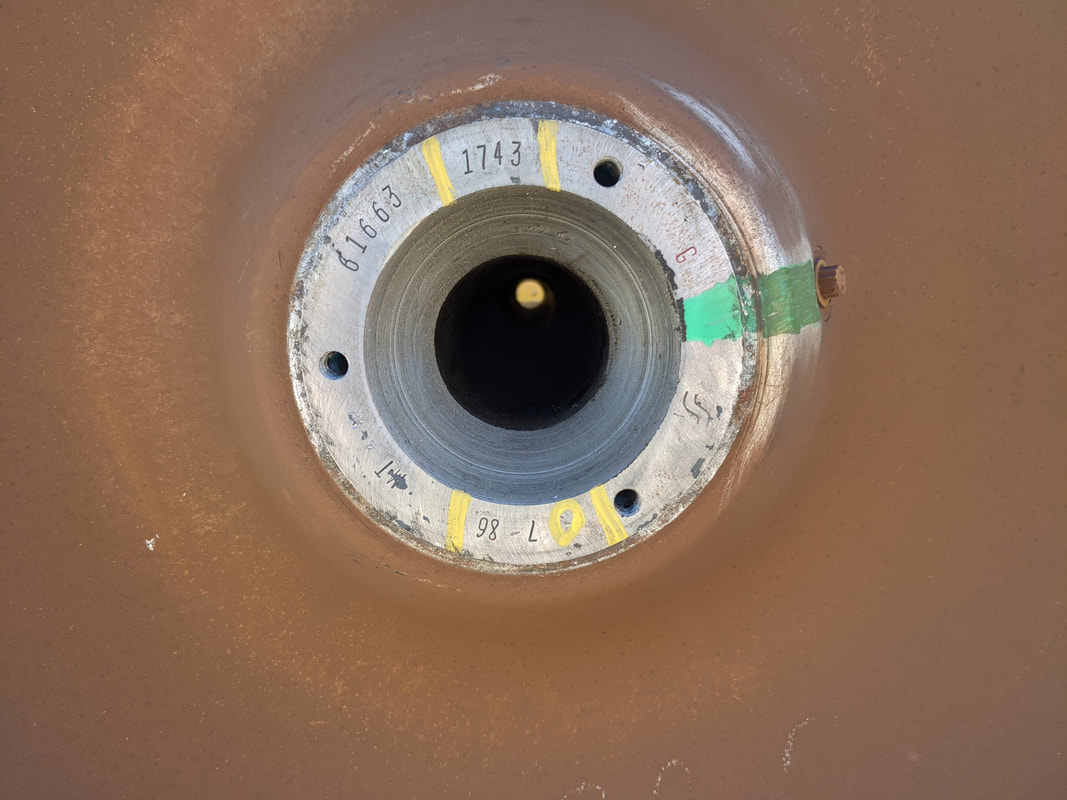 Overall, the truck is in excellent condition and with a few more parts, will be a complete B2 car truck. This truck will help the BART car preservation effort by providing numerous measurements to ensure safe movement and storage of three BART legacy cars in WRM’s Carbarn 3. 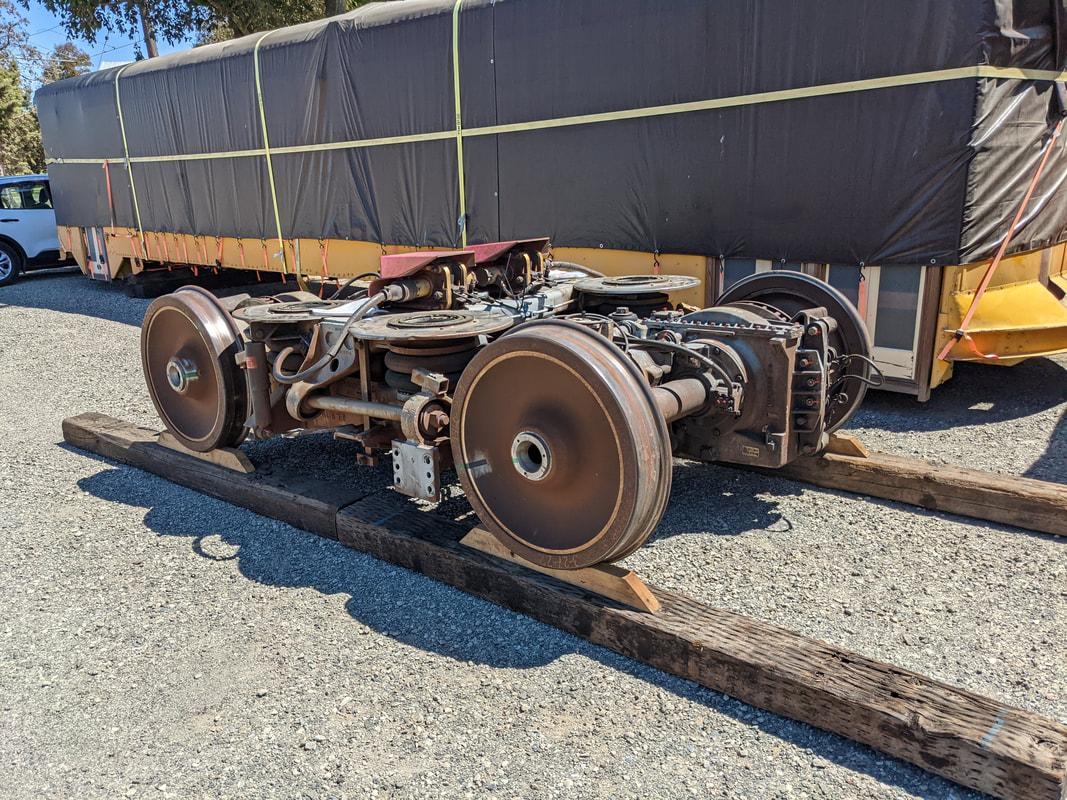
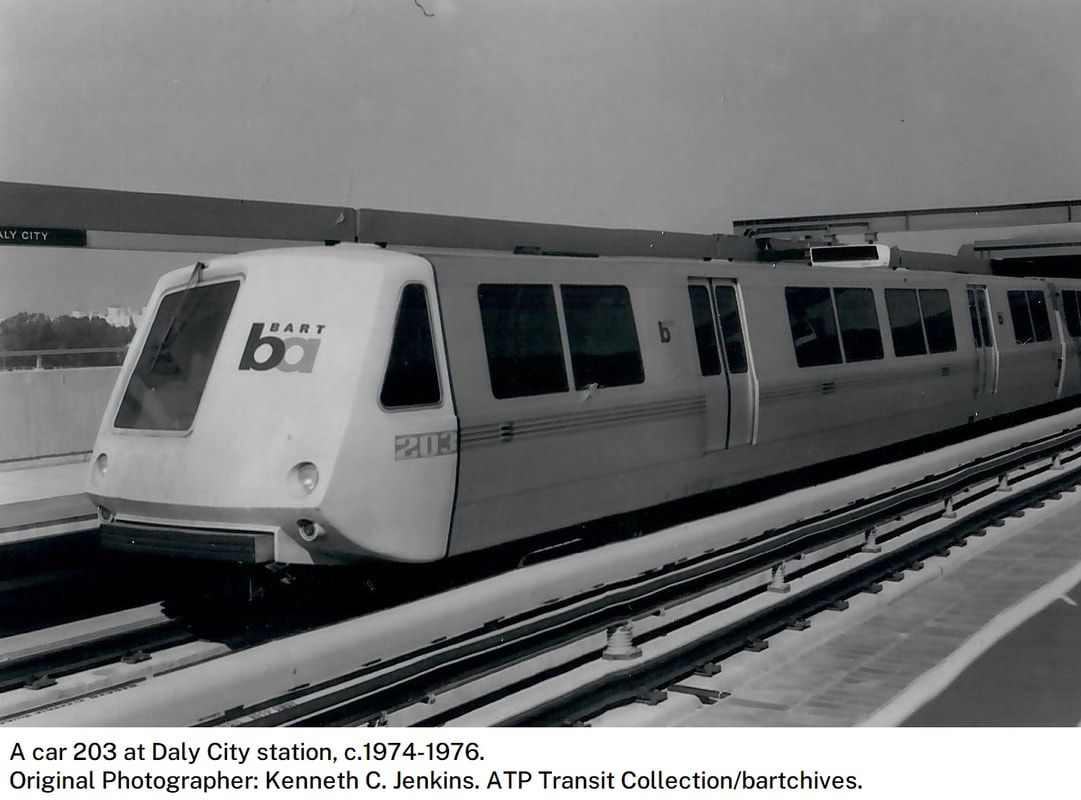
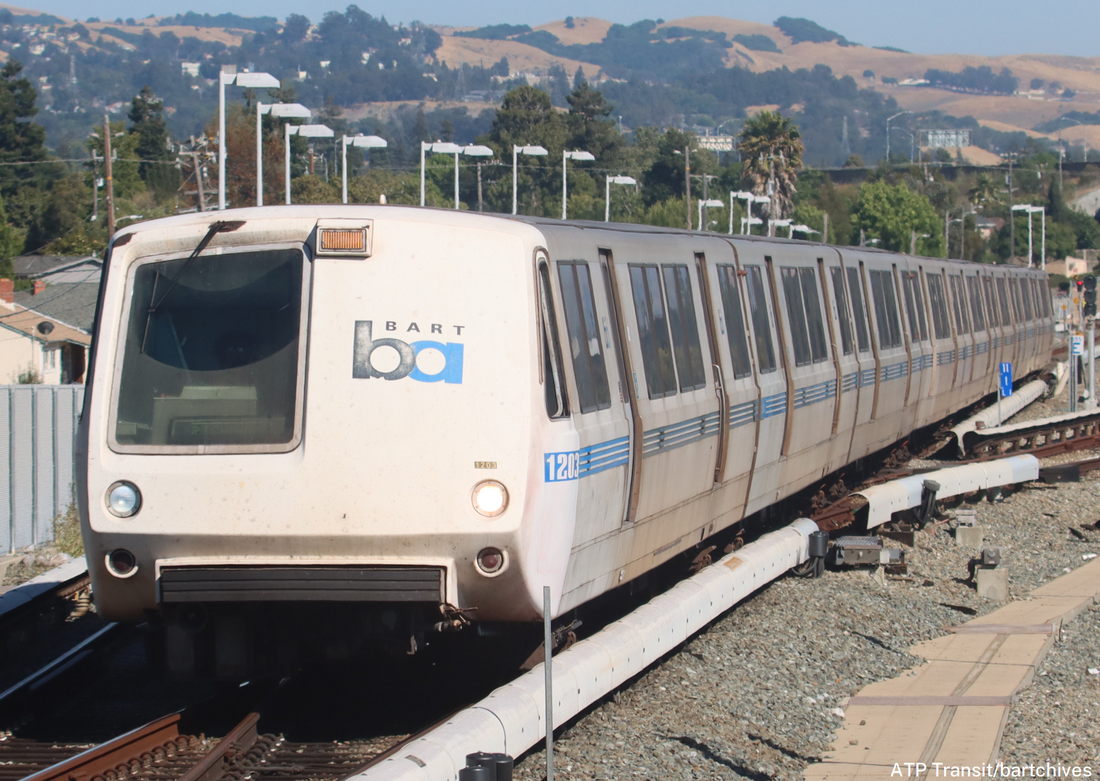
This year, the oldest A (technically, A2) cars reach the 50-year mark - a half century since their original construction. One such example is A2 car 1203, originally built by Rohr as A car 203. To note, A2 cars 1164-1250 were built in 1973 and 1251-1276 were built in 1975.
The first order for BART revenue vehicles consisted of 250 cars - 150 A cars and 100 B cars. The 203 was built within this order, and about the 156th car off the assembly line. It was delivered to BART in March 1973 and entered service within the year. Further orders for cars resulted in a fleet sized to be 176 A cars and 274 B cars (but never totally achieved). By the 1990s, the A/B cars were a bit long in the tooth and in need of a rebuilding. The midlife refurbishment program included the rebuilding of A car 203 into A2 car 1203 in 2001. Now, about 22 years and 2.2 million miles later, the legacy fleet is steadily being replaced by the Fleet of the Future. The 1203 will probably meet its end thorough scrapping, or it may be among the chosen few BART cars to find a second (or perhaps third) life in an alternative use. Whatever the case, here are a couple pics of a “young” 203 in the 1970s and an “old” 1203 in 2023 – the former from my collection and the latter taken this month (with a dead headlight nonetheless). (To note, A cars in service in 1972 are all now B2 cars numbered in the 1800s-1900s, leaving the oldest A2 car as the 1164, delivered in January 1973). Side note: The story of the BART legacy cars is not one which can be shortened to a series of posts here and crossposted in other places. I am working on a book covering the history of the BART fleet, from design to retirement, and it is fast approaching 400 pages chocked full of detail and pictures. What would you like to see in such a book and how would you gauge interest in such a subject? Please feel free to contact me on the "about" page of the website. Thanks! 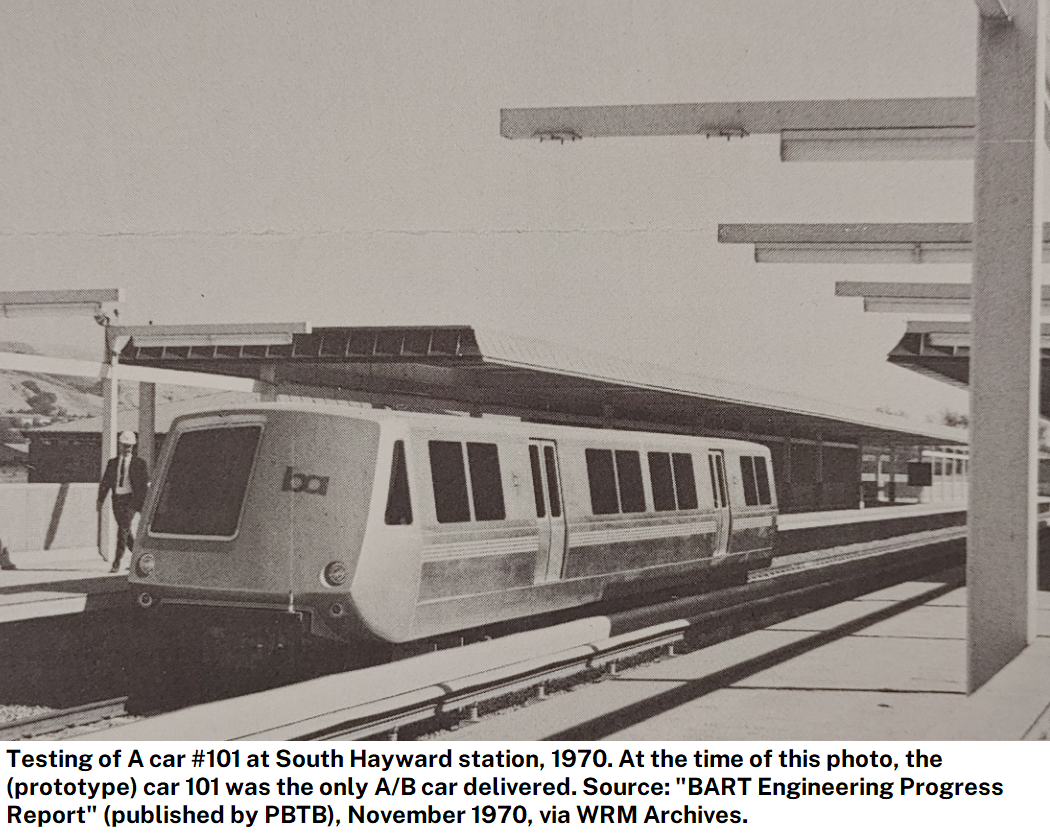 The first BART car off of the Rohr assembly line was A car #101, one of ten prototype cars designed to resolve planned and unplanned “bugs” with the BART cars. The 101 was delivered in August 1970, and was the only A car rolling around until mid-November, thus the picture of this short “one car train.” Also note the silver painted cab – the prototype cars had an odd variety of “liveries.”
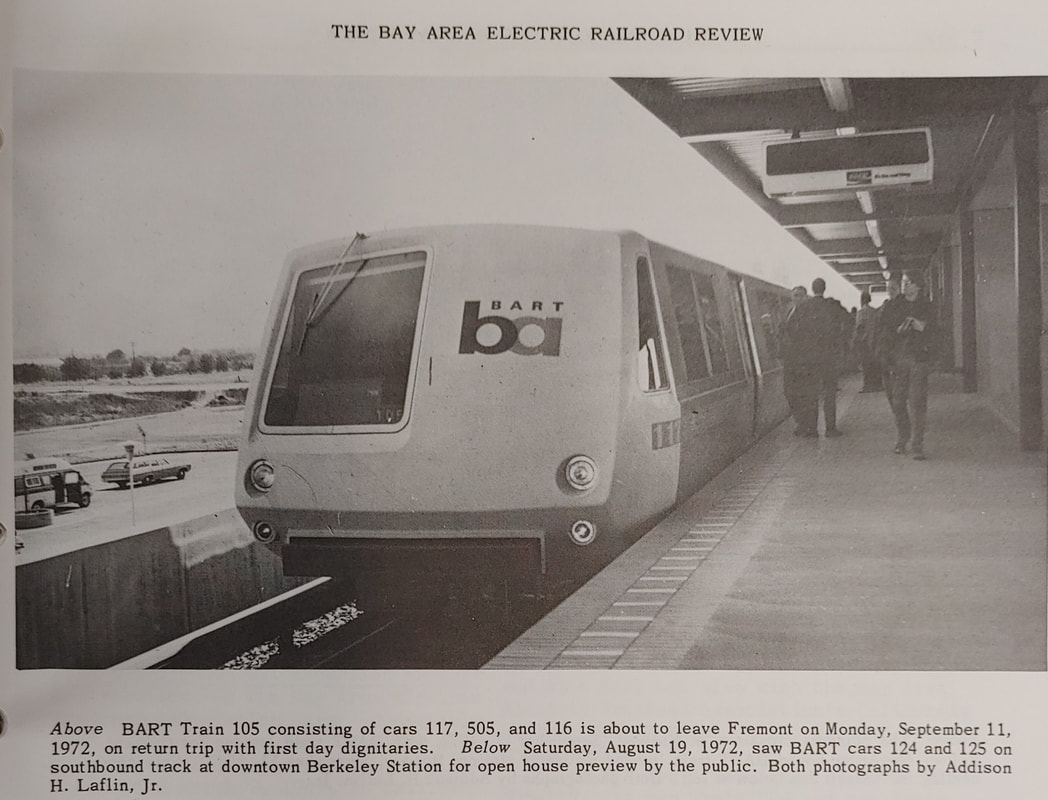
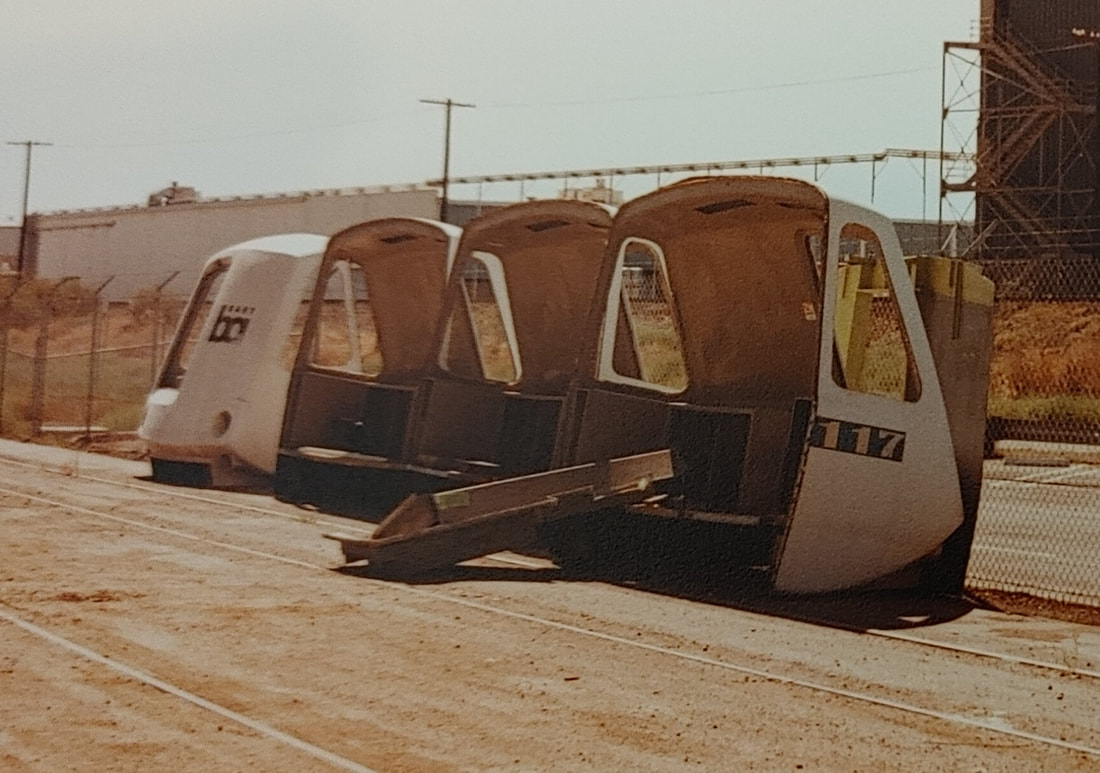
To note, at the time there were three boxy “Laboratory Cars” which also operated up and down the “[Southern] Alameda line.” They were originally built for operation on the Diablo Test Track located in Concord. At the conclusion of the prototype car testing program, most of the “dented and battered” prototype cars were replaced with production cars of the same number. The original 101 was scrapped and the new replacement 101 rolled for a few years until becoming B car 821, thence B2 car 1821 (and scrapped). B2 Car 1806 is, on first look, just any old B car. It runs in the middle of trains, and seats 53 people. It has a few smells and a few bulbs are out. Underneath all that, B2 car 1806 is one of many historic BART cars. 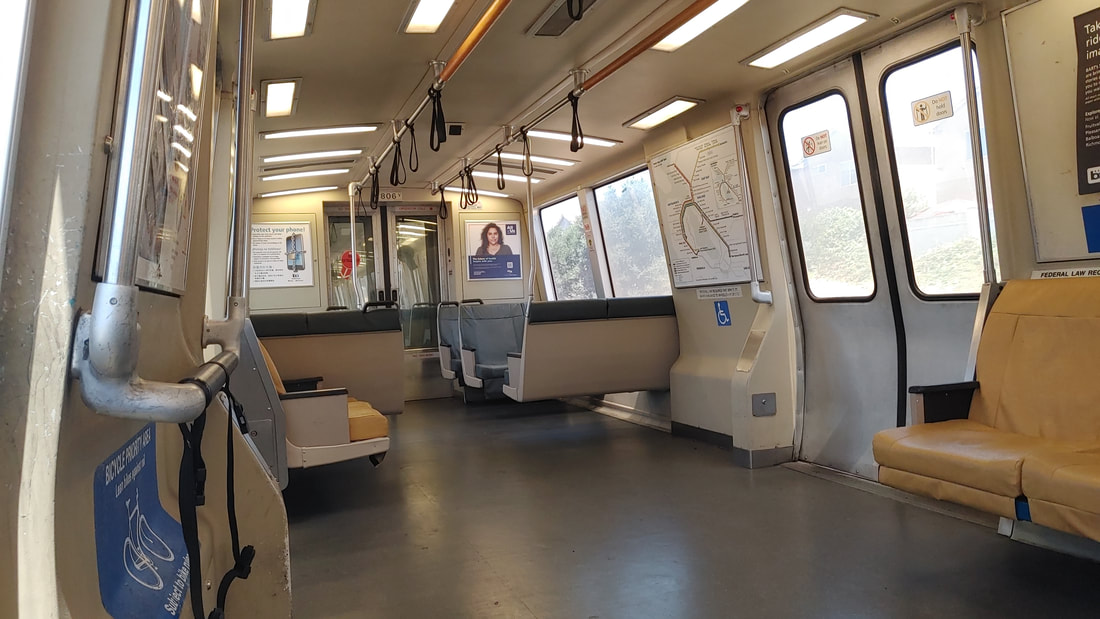 The 1806 was originally built by Rohr as A car 117. It was among the first two dozen BART legacy cars built. It was built in Chula Vista, CA, and delivered to BART's Hayward Yard on 5/16/1972. It was used for pre-revenue testing of the BART system, and entered service on BART's opening day, Septmeber 11, 1972.
By the 1980s, many A cars were worn out and/or damaged. BART was a new railroad and in some ways, still learning the ropes - there are accounts of runaway cars, collisions, and fire damage during these early days. Car 117, alongside 34 other A cars, were destined to become B cars. The unique design of the A cars facilitated such conversion (which was miles cheaper and faster than building new B cars). A car 117 became B car 806 in about late 1980. The "new" 806 rolled in service until its midlife refurbishment in 2001. 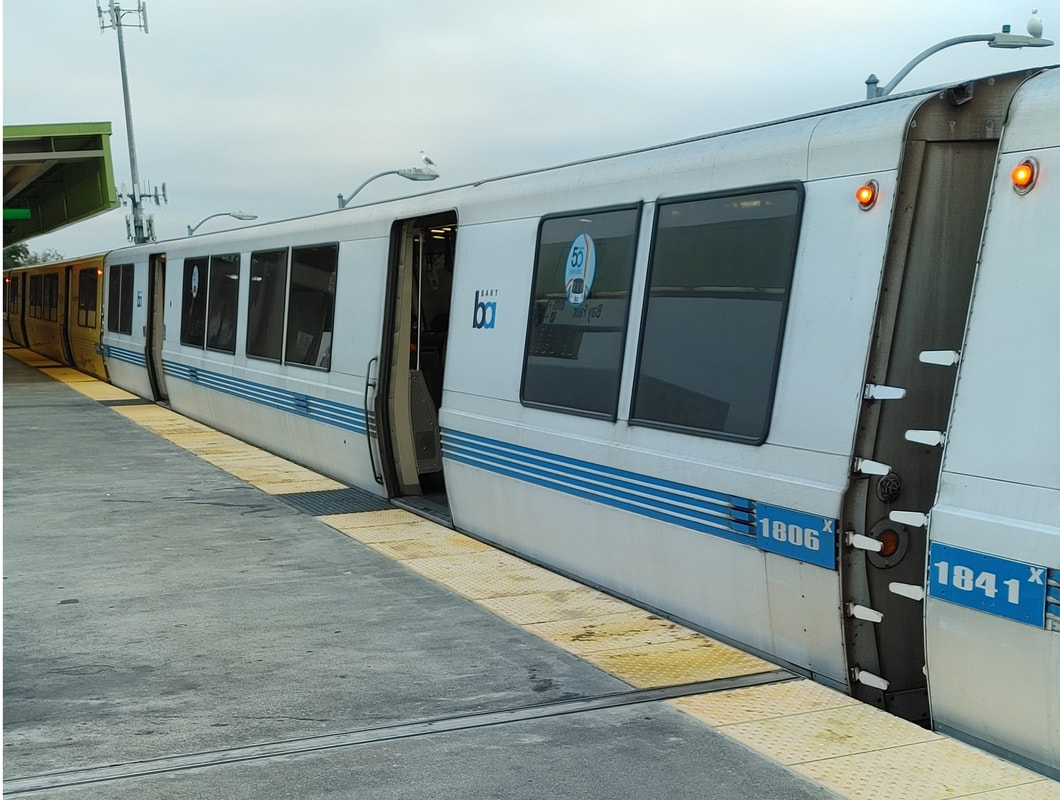 As a product of the refurbishment, B car 806 became B2 car 1806. The 1806 is still in service, far beyond the original intention of its designers. This old car will probably be scrapped this year or next year, but if anything, it has carried the millions through thick and thin for over 50 years.
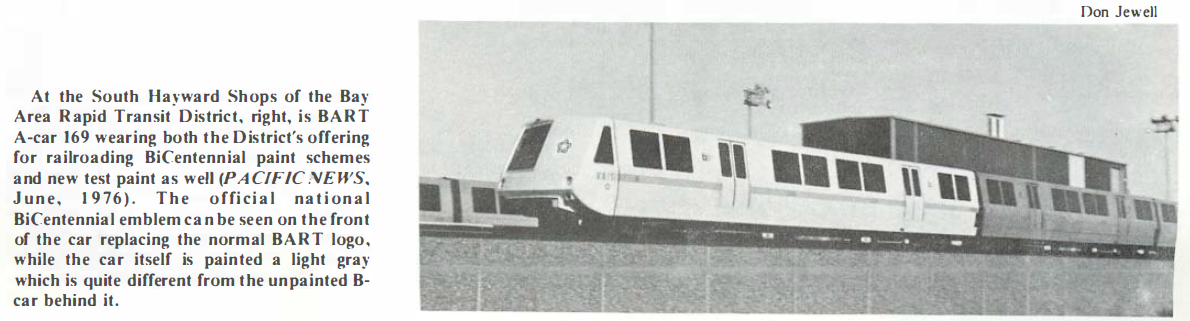
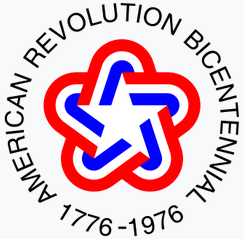
BART was not one to miss the bicentennial celebration; they replaced the front logo of about a dozen A cars with the official Bicentennial Logo, along with smaller versions of the same logo on the sides below the Y end car number. It wasn’t to the extravagance of many conventional railroads with their specially painted units, but it was still a nod to the 200th Anniversary of the founding of this country.
Picture from Pacific News, July 1976 issue
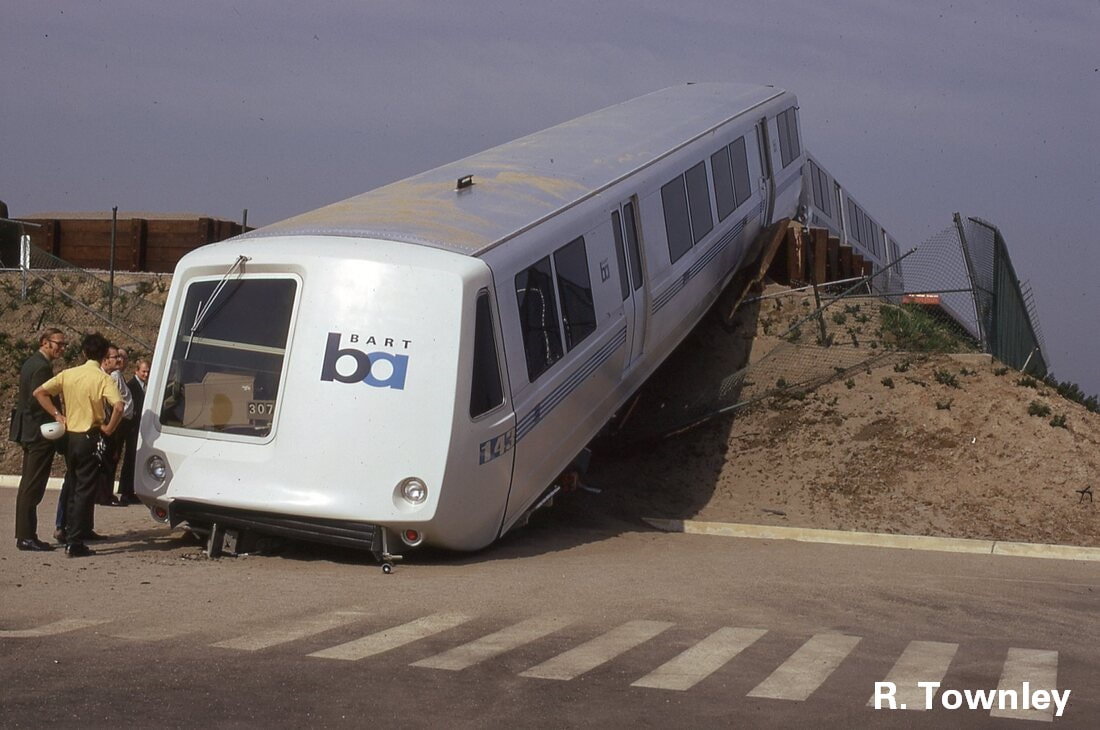
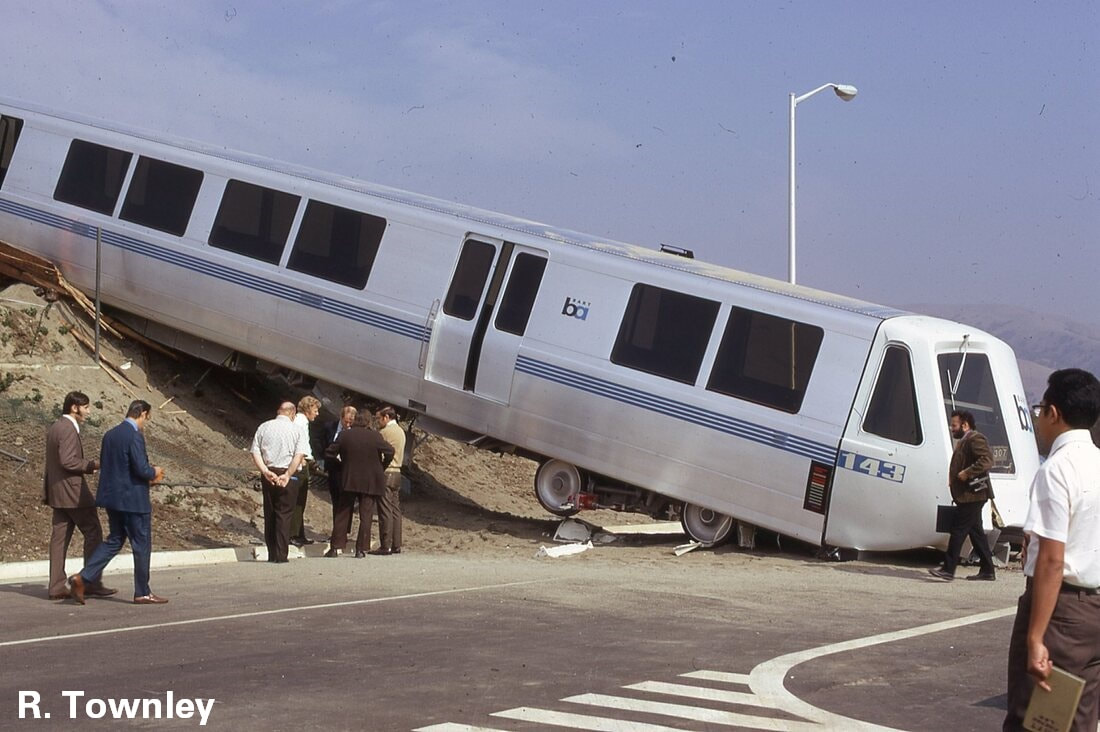
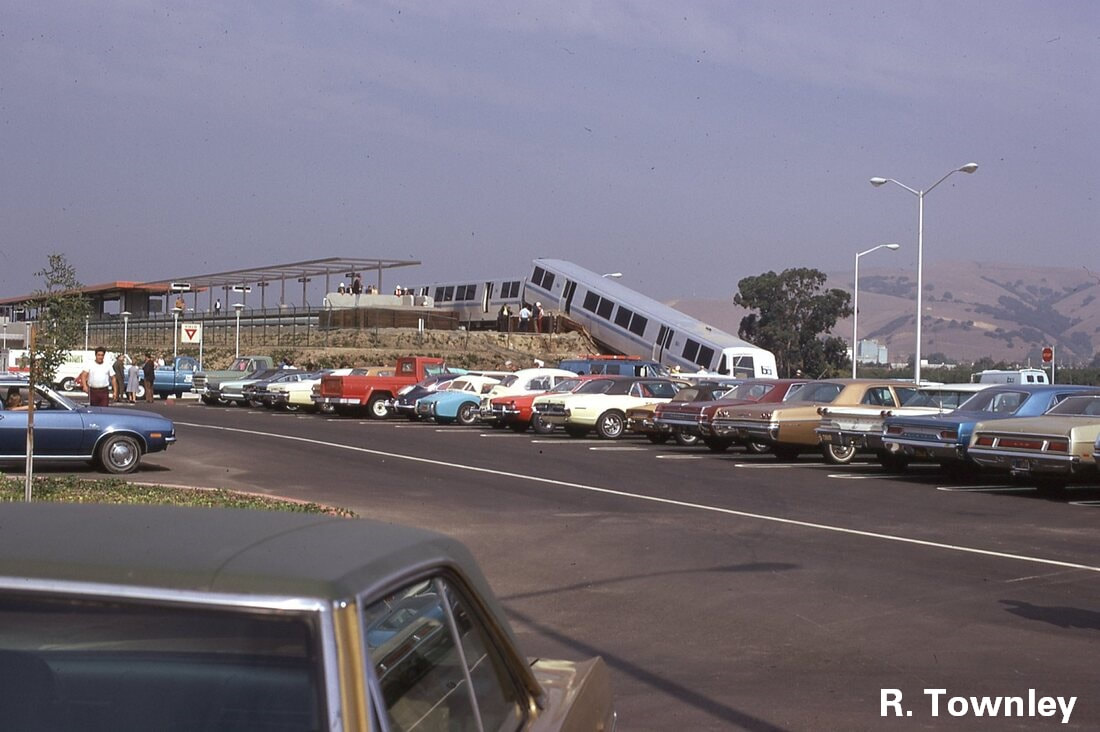
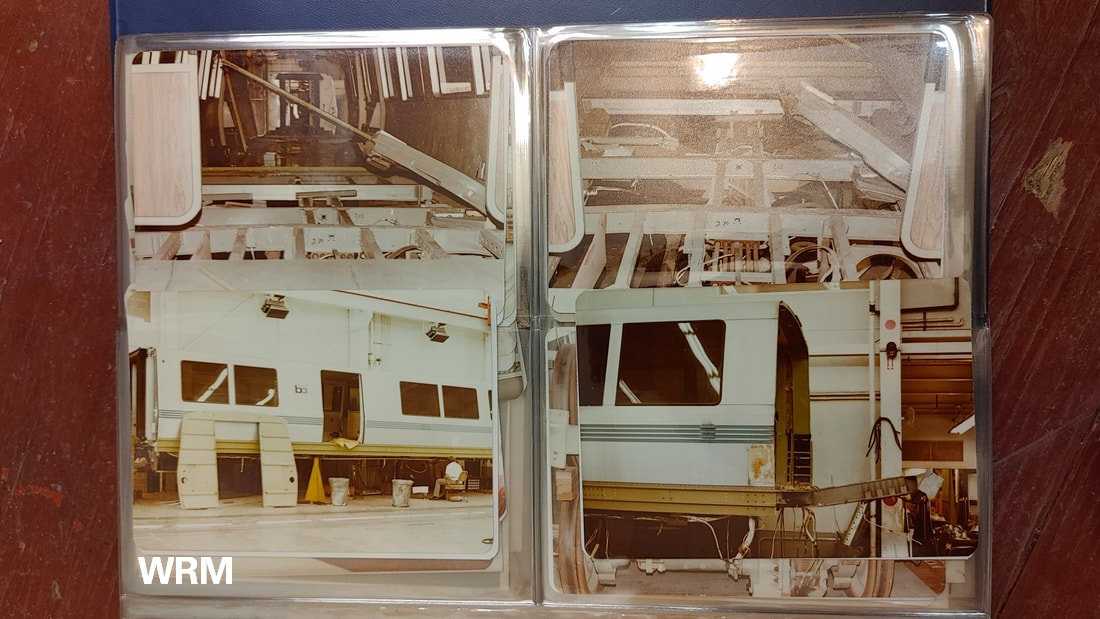
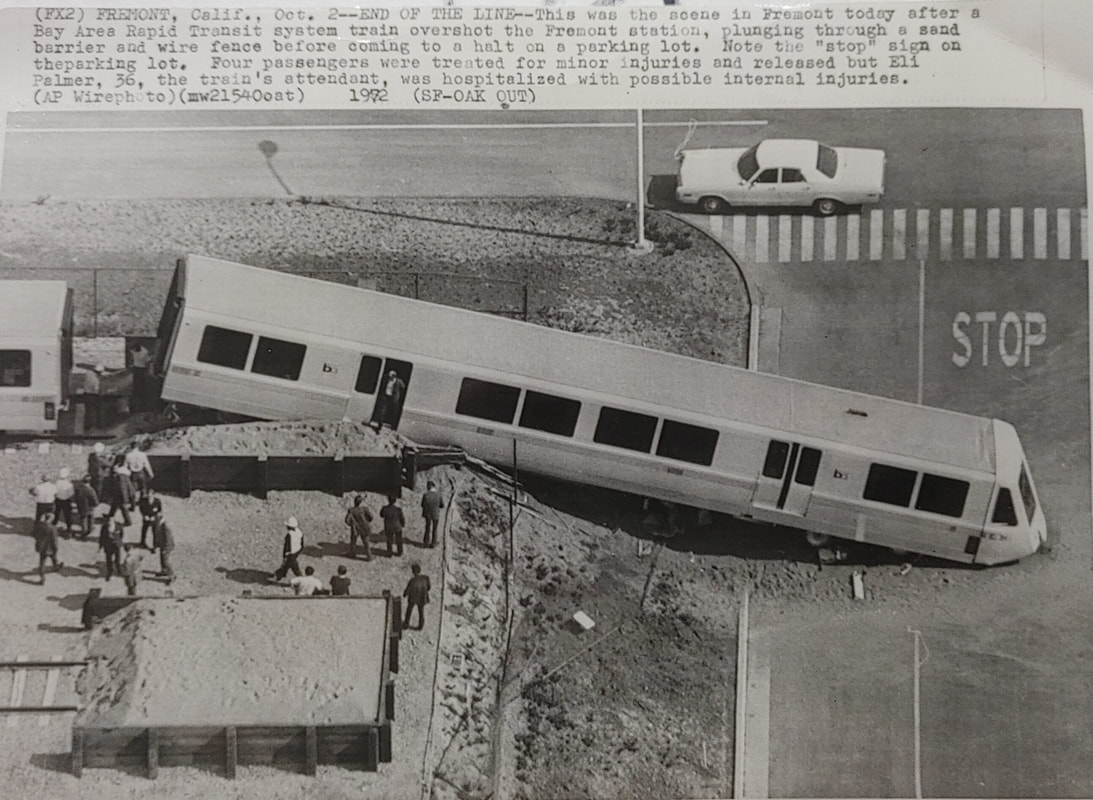
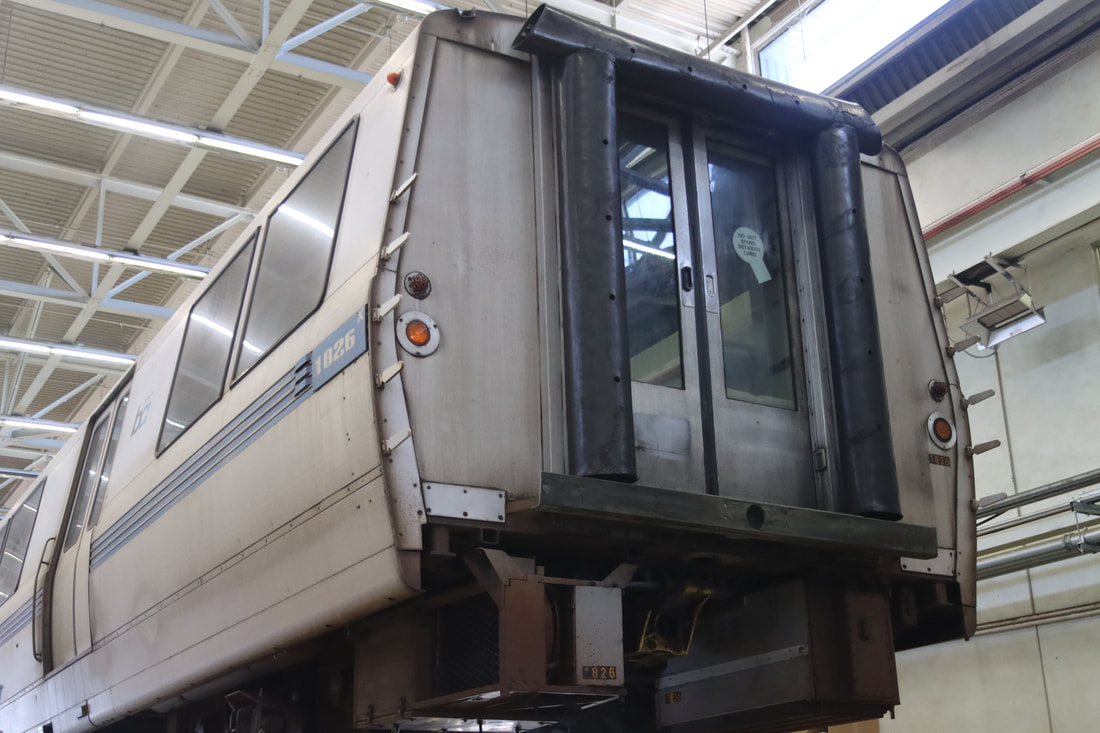
Today marks the final chapter of one of BART’s most historic Legacy Cars: the Fremont Flyer. The Fremont Flyer was originally known as A car 143, the 48th car off of the Rohr assembly line in Chula Vista, CA. The car was delivered to Hayward Yard on August 31, 1972, less than two weeks ahead of BART’s opening day, and underwent testing to ensure the car was ready for revenue service – or so it was thought. The shiny new 143 entered revenue service on October 2, 1972, filling in for two broken down trains. Dispatched as Train 307, a short two car train with A cars 143 and A car 118 – the latter was a “Day One veteran” – headed south from Hayward Yard to Fremont station (143 leading), thence to MacArthur (118 leading), the northern terminus at the time. Train 307 then headed south to Fremont. While approaching the A85 interlocking just north of Fremont station, the train received a 27-mph speed code – one of eight discreet speed codes on the BART ATC system – to ensure the train would safely cross over from track 1 to track 2 and stop within the platform. Unbeknownst to anyone on the train, a tiny yet faulty crystal, controlling an oscillator on a printed circuit board, incorrectly decoded the speed code to mean the train should speed up to almost 70 mph – which it achieved. Crossing over the A85 interlocking at 66 mph, the train attendant recognized something was amiss and did all that was possible to stop the train (including pressing the stop button so hard he broke the mounting and pushed it through the console). Even then, the braking was inadequate; the train sped through the center of platform 2 at 42-50 mph and impacted the sandpile at about 26-33 mph (sources debate speeds), continued and landed in the parking lot – short of a stop sign. Injured riders and the train attendant were rushed to the nearby Washington Hospital.
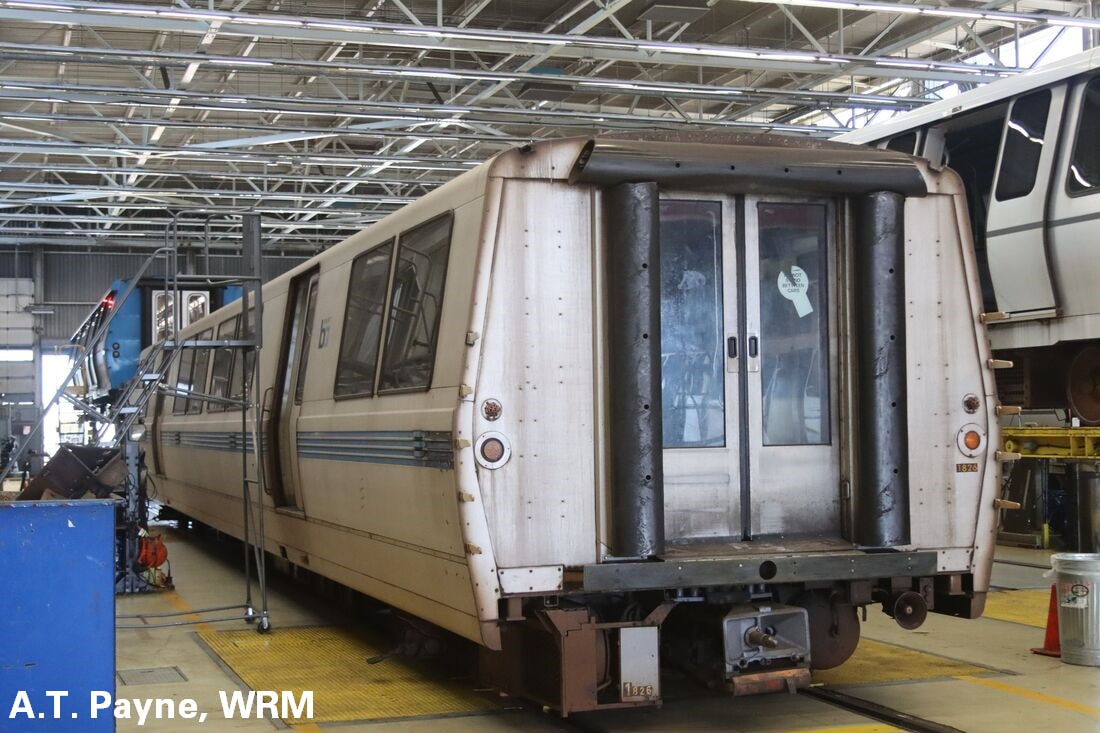
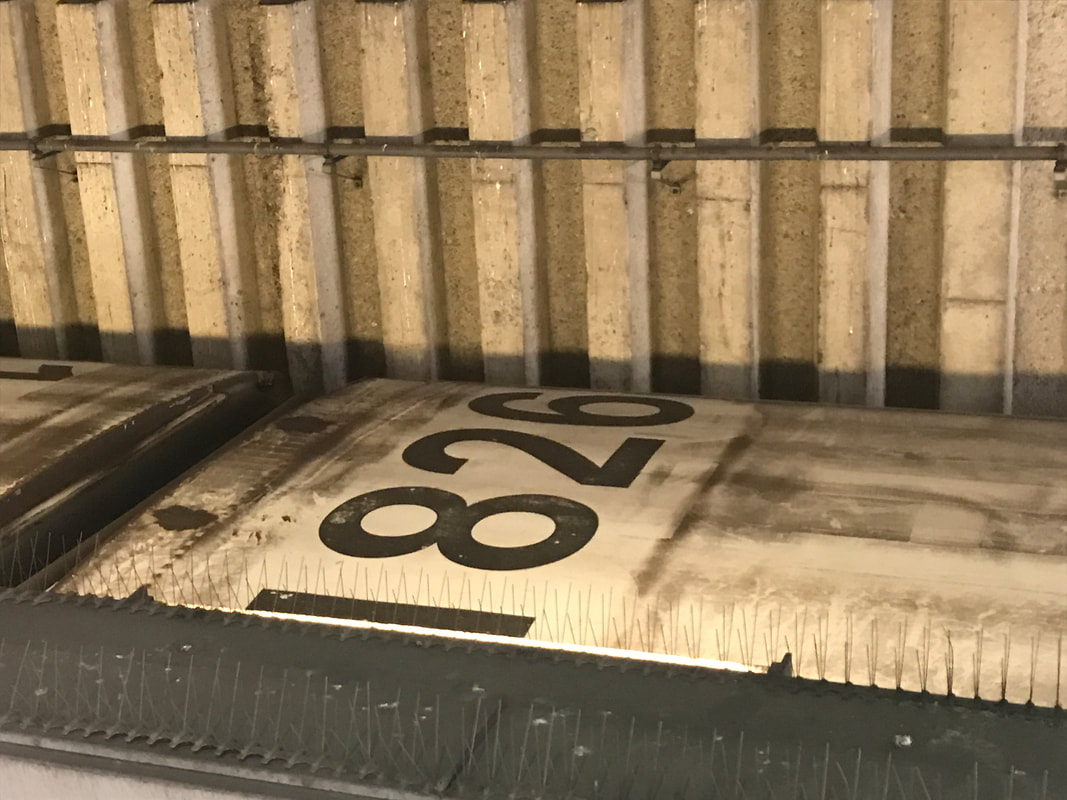
The accident brought national attention to the safety of BART, alongside significant changes to carborne ATC equipment and changes across the system. Such changes included, but were not limited to, additional circuitry to ensure the decoding of the correct speed code, alongside the addition of wayside markers showing where a train should start braking and the maximum speed. Years of revisions and refinement to the ATC system following the Fremont Flyer incident has made BART a safer system for all who ride it. A car 143 never carried another paying rider but it found a new life as a B car. In fact, the damage was severe enough for the BART forces to recommend salvaging parts and scrapping the car. Fortunately, BART engineering know-how was on its side and the 143 was repairs and converted into B car 826 by Hayward Shop forces by the end of 1981. It then rolled again, this time as a standard B car for about 20 years.
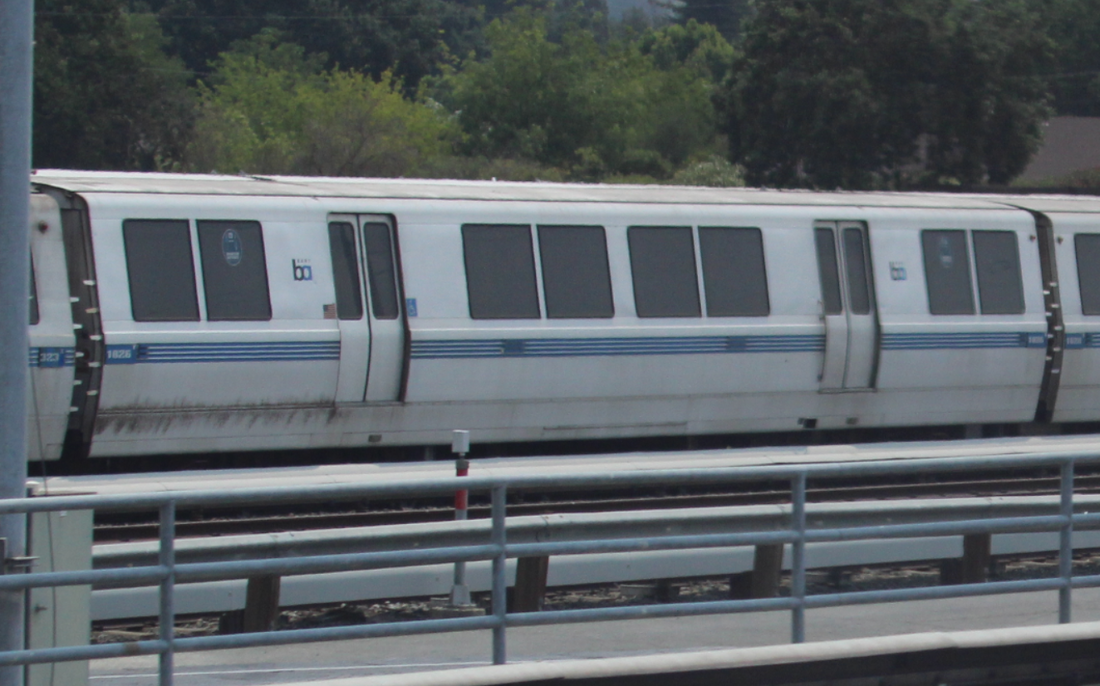
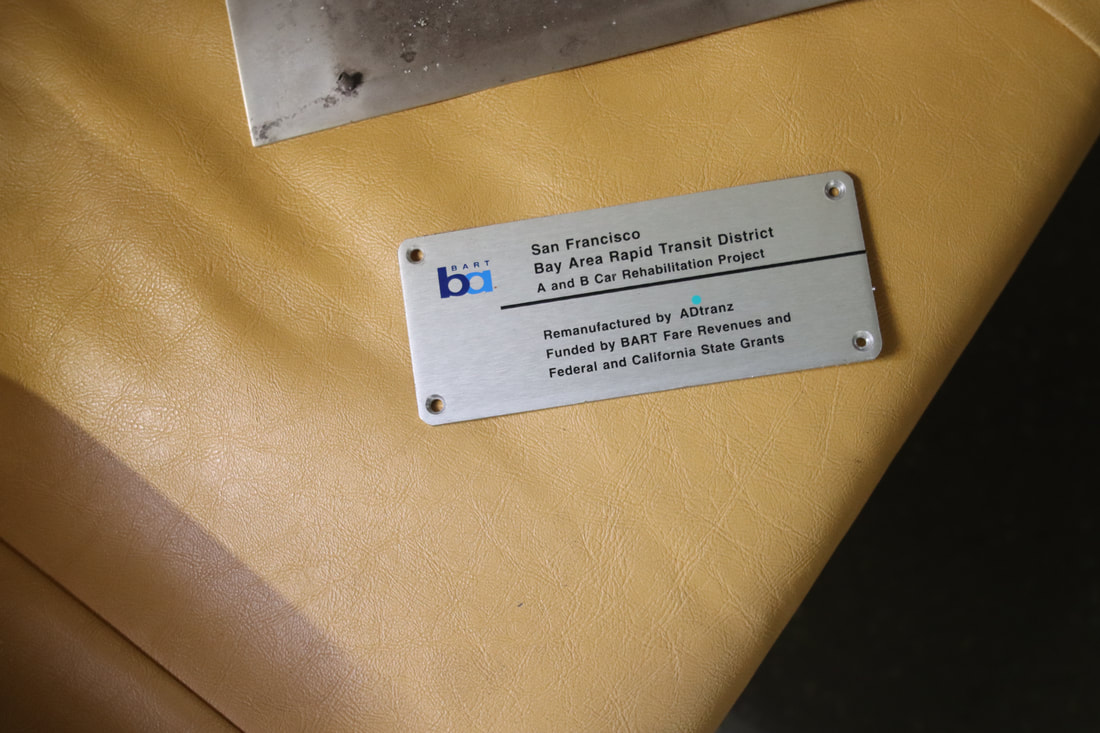
As part of the A and B car refurbishment of the A and B cars during the turn of the century, B car 826 was rebuilt and renumbered into B2 car 1826. In its final years, it was assigned to Concord yard and seen in the middle of long Yellow line trains. After this major incident, but then a successful repair and conversion, old 143 carried thousands of passengers millions of miles. BART is currently replacing their Legacy Cars with the Fleet of the Future cars. The Fremont Flyer was no exception to this, and after 50 years since it first entered revenue service, this car was decommissioned. BART forces also recognized the historical importance of this car, and invited Western Railway Museum volunteers to preserve artifacts from this car for posterity and for use in the future Rapid Transit History Center. WRM volunteers were able to identify the Y end (once cab end) exterior and interior number plates, the ADtranz rebuilding plate (c. 2001), and a seat. These artifacts will help tell us tell the story of one of the most historic transit vehicles of the BART legacy fleet.
This article was written by ATP Transit for the Western Railway Museum.
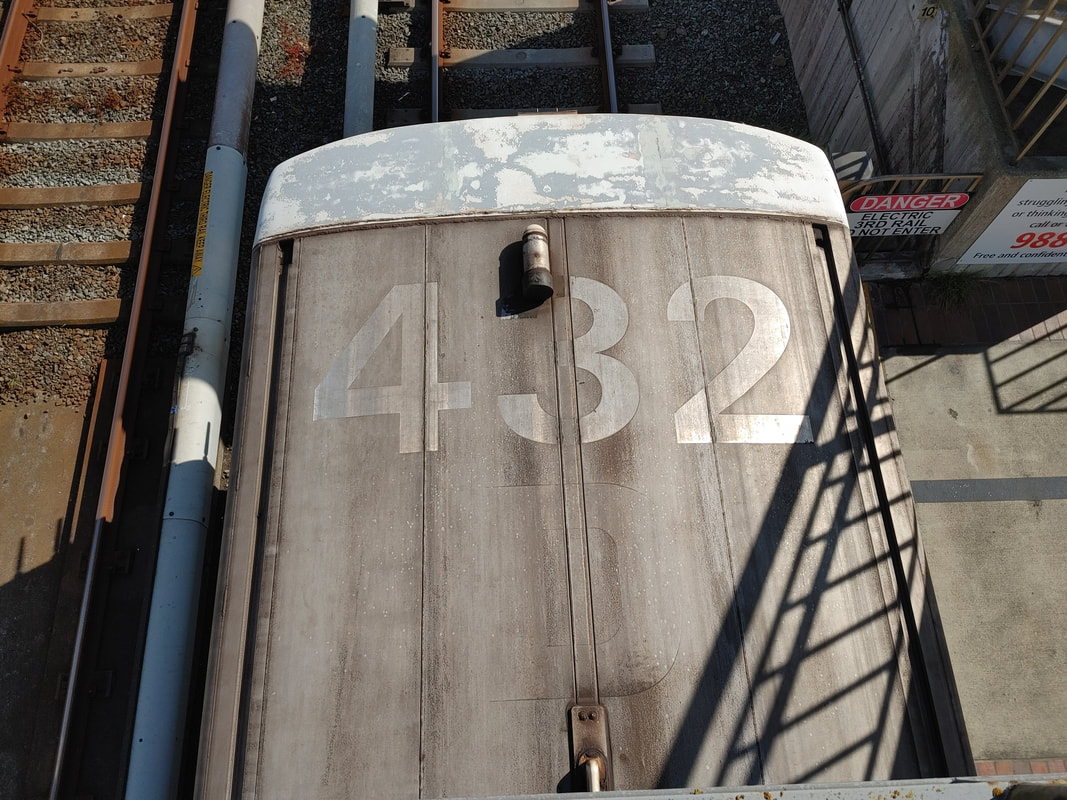
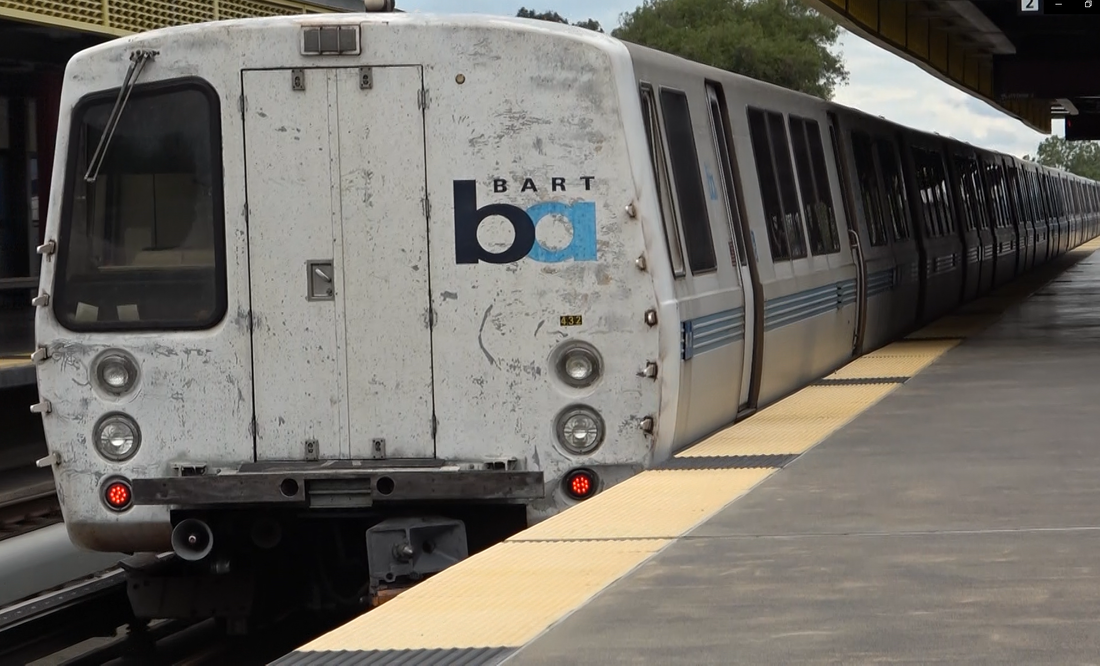
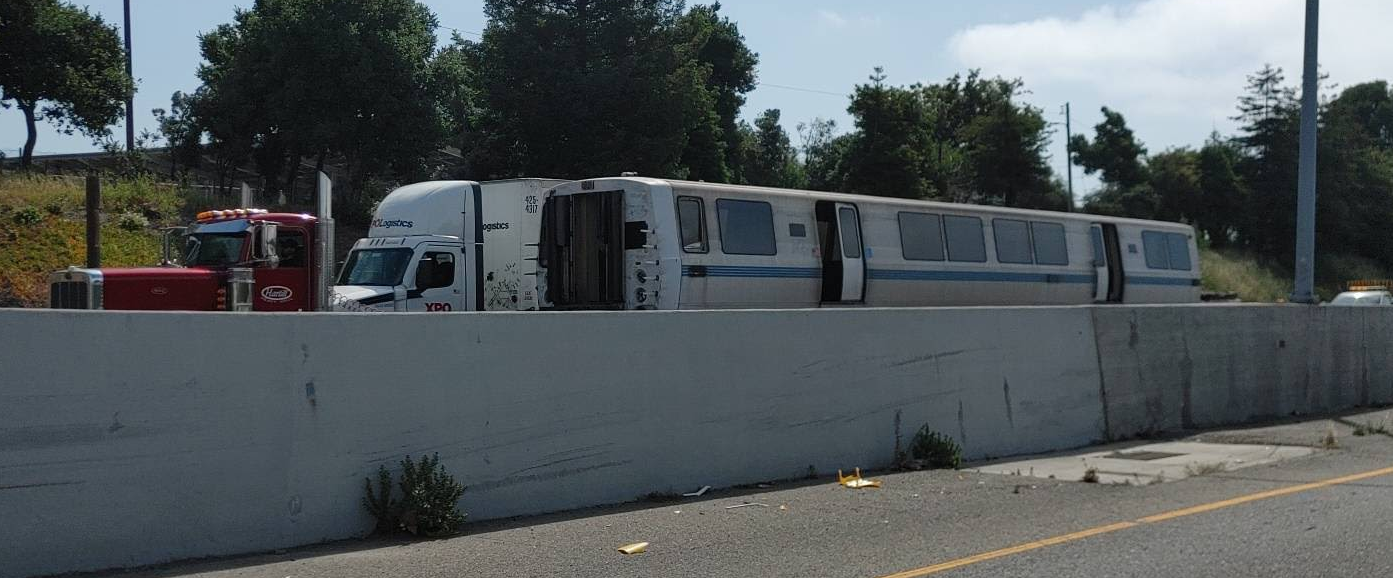
Now that it appears no C cars are seen in service on a daily basis, I think it’s fitting to take a look at one of those final C cars I rode earlier in the month, and saw on the way to the scrapper this morning – car 432. The C cars were the closest match to the sounds of early BART into the 2020s. The 432 was just one of 150 Alsthom-built C cars ordered to supplement the existing Rohr-built A/B cars. The C cars were designed to be used as mid cars (like a B car) or as lead or trail cars (like an A car), providing greater operational flexibility. Additionally, the C cars included some technical changes designed to increase reliability compared to the troubles experienced with the A/B cars in the 1970s. Numbered well into the production run (#301-450), this C car entered service in 1989. With the introduction of the C2s in the late 1990s, the original 150 C cars were also known as C1 cars. By 2023, the 432 had been in service for 34 years and rolled over 3 million miles. Something unique about this car in particular was a bit of a dent or two near the tail light on the Y end, alongside the various scrapes of the white cab paint, revealing the aluminum carbody below. The C1 cars were a bit of a reminder of BART’s past. Never rehabilitated (like the A2/B2 cars), the C cars retained the original faux-wood arm rests and DC propulsion like the original A/B cars. It was hard to mistake a C car in a consist, buzzing and humming the same notes, while the variable pitch A2/B2 cars would whine chromatically. BART’s car retirement plans outlined the C2s to be scrapped first, followed by the C1 cars, and finally the A2 and B2 cars (to note, some A2/B2 have been scrapped between C2s and C1s, for various reasons and considerations). Like over 100 other C1 cars, the 432 exited revenue service, was stripped of useful parts, and trucked away to the scrapper. I last rode it on May 5th (and even rode it on May 4th – and turned in a lost phone, to beat), and today (May 22nd), saw it while driving down 880 on the way to the scrapper. With that unique dent, it wasn’t hard to identify even with the number plates removed. The car has almost certainly been chopped to pieces now. With modern metal recycling technology, it will be recycled and the various metals may find new useful roles. Perhaps one day, you might find what was once 432 in another role – maybe as an aluminum drink can, or some of its steel might be part of a beam in a new building. The 432 will also live on in N scale, being one of the cars I constructed a few weeks ago. My N scale BART fleet has carefully chosen cars to represent various eras of BART history, and the 432 represents one of the last C1 cars in service. Farewell 432. |
About
"The Two Bagger" is meant to be a place to store more "blog" style posts on various cars, pictures, and random tidbits. At BART, a "two bagger" is a rather informal name for a two car train. Two car trains rolled in revenue service back in 1972. Archives
April 2024
Categories
All
|





 RSS Feed
